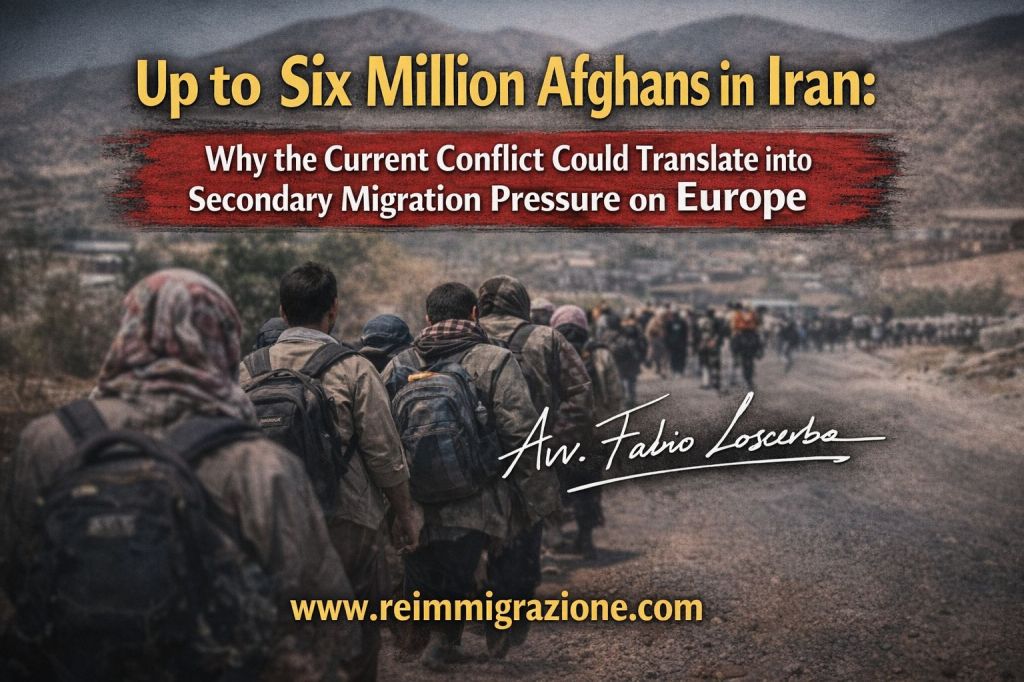
The military escalation involving Iran is not only a Middle East security story. It also has predictable second-order effects on migration dynamics, and Europe sits directly on the downstream side of those effects. Iran hosts a very large Afghan population—often estimated in the range of four to six million people, including a smaller registered refugee component and a much larger group living with precarious or informal status. When a host country that functions as a “first asylum” environment enters a phase of instability, the core migration logic is straightforward: people who were already living in legal and economic fragility tend to move again, not because they suddenly become “new” refugees from their country of origin, but because the host state can no longer provide basic security, work opportunities, or predictable rule-of-law conditions.
This is the key point American audiences should keep in mind: the potential movement is not necessarily an Afghanistan-to-Europe story; it can quickly become an Iran-to-Europe story. Secondary migration is not an ideological claim, it is a documented pattern. If inflation spikes, informal labor markets collapse, policing intensifies, or internal security deteriorates, Afghan communities in Iran will face an immediate calculus: remain in a deteriorating environment with limited legal protections, or attempt to reach a more stable jurisdiction. For many, the most plausible corridor is the well-known route through Turkey and onward to the European Union.
A mass movement of “millions” is not the most likely scenario in the short term, but Europe does not need a total exodus to face a serious challenge. Even a small share of a very large population can translate into hundreds of thousands of people on the move over a relatively short period. Once flows begin, they are difficult to manage through political statements alone; they respond to conditions on the ground, to smuggling capacity, and to perceived access to safety and long-term stability.
There is an additional, practical dimension that European policymakers cannot ignore: integration capacity. When large groups arrive within compressed time frames, integration becomes harder—structurally, not morally. Language acquisition, skills recognition, labor market entry, civic participation, and compliance with host-country rules all take time and resources. Many Afghans who have lived in Iran for years have done so in marginal conditions, often in informal employment and with uneven access to schooling or professional training. That background can make integration in European societies more demanding, especially when reception systems are already under strain and public opinion is polarized. This is not a value judgment; it is a technical reality about social systems under load.
From a United States perspective, the relevance is not to treat this as an internal European debate, but as a stability question affecting NATO partners and the broader transatlantic space. Europe’s ability to absorb sudden migration pressure influences domestic cohesion, border governance, internal security priorities, and political stability. In turn, that affects coordination on sanctions, defense posture, and broader Middle East strategy. In other words, migration pressure is often the “silent variable” that turns a regional conflict into a longer-term strategic complication for Western alliances.
For that reason, a sober, technical assessment is warranted. The risk is not inevitable, but it is real. If the conflict in Iran continues to destabilize the country’s economy and internal security, Afghan communities—already living in precarious conditions—are among the first populations likely to move. Europe is the most plausible destination. The timing and scale will depend on how quickly Iran’s internal conditions deteriorate and how effectively transit routes are controlled, but the underlying mechanism is clear: instability in a major host country can convert a long-standing refugee presence into outward secondary flows.
This is exactly the type of scenario that should be anticipated early, discussed without partisan framing, and addressed through pragmatic coordination: stabilizing conditions where possible, supporting controlled and lawful pathways where appropriate, and strengthening integration capacity and enforcement in destination countries so that social systems do not get overwhelmed. Ignoring the migration dimension until it becomes an emergency has historically been the costliest option.
Avv. Fabio Loscerbo
ORCID: https://orcid.org/0009-0004-7030-0428
EU Transparency Register ID 280782895721-36
- Protezione complementare e nuovo Patto UE: a Bologna un corso di formazione nel giorno dell’entrata in vigore dei regolamenti europei
- Remigrazione e Riconquista: perché manca la parola più importante, integrazione
- Der italienische Kassationsgerichtshof sagt: Integration muss bei Abschiebungen berücksichtigt werden
- La Remigrazione non basta: il vero problema è l’assenza di una politica dell’integrazione
- La decisione del giudice federale John J. McConnell Jr. (U.S. District Court for the District of Rhode Island) e il tema dell’integrazione nelle politiche migratorie
- Il limite della Remigrazione: sostituisce l’economia con l’identità ma dimentica l’integrazione
- La Svezia abolisce i permessi permanenti: verso un’immigrazione basata sull’integrazione
- “Remigrazione, Vannacci attacca Giorgia Meloni: ‘Gli immigrati vanno deportati’” – perché il dibattito continua a ignorare il tema dell’integrazione
- “CPR in Toscana, l’appello di oltre 40 associazioni contro l’apertura ad Aulla ed altrove” – il problema non è il CPR, ma l’assenza di una politica dell’integrazione
- L’Italia impari da Belfast: il dovere di integrazione deve entrare nella Costituzione
- Da Belfast una domanda all’Europa: integrazione o conflitto?
- Unione Terre di Pianura e welfare: l’integrazione può ridurre i costi dell’assistenza?
- La Cour suprême italienne affirme que l’intégration doit compter dans les décisions d’éloignement
- Integrazione, CPR e ReImmigrazione: il modello della permanenza condizionata
- Italy’s Supreme Court Says Integration Matters in Deportation Cases
- Integrazione, CPR e ReImmigrazione: un modello alternativo per governare l’immigrazione
- Belfast e il nodo irrisolto dell’integrazione
- From Complementary Protection to the Integration or ReImmigration Paradigm: Reflections on Recent Decisions of the Court of Bologna
- La Cassazione e il nuovo equilibrio tra integrazione e rimpatrio
- Dal Sudafrica una lezione per l’Europa: ignorare l’integrazione alimenta il conflitto sociale
- Simone Leoni e Francesca Totolo riaprono il dibattito: ma come si misura davvero l’integrazione?
- Il saldo fiscale non basta: il vero banco di prova è l’integrazione
- De la protección complementaria al paradigma “Integración o ReInmigración”: reflexiones a partir de recientes decisiones del Tribunal de Bolonia
- Accordi di integrazione in Europa: cosa funziona e cosa manca in Italia
- La Corte Suprema italiana afirma que la integración debe contar en las decisiones de expulsión
- Dal D-Day all’immigrazione: il messaggio di Pete Hegseth all’Europa
- New Jersey contro GEO Group: il caso Delaney Hall e il ruolo dello Stato nelle politiche migratorie
- Vom ergänzenden Schutz zum Paradigma „Integration oder ReImmigration“: Überlegungen zu aktuellen Entscheidungen des Gerichts von Bologna
- La realtà demografica di Malalbergo tra presenza straniera e seconde generazioni


Lascia un commento