Abstract
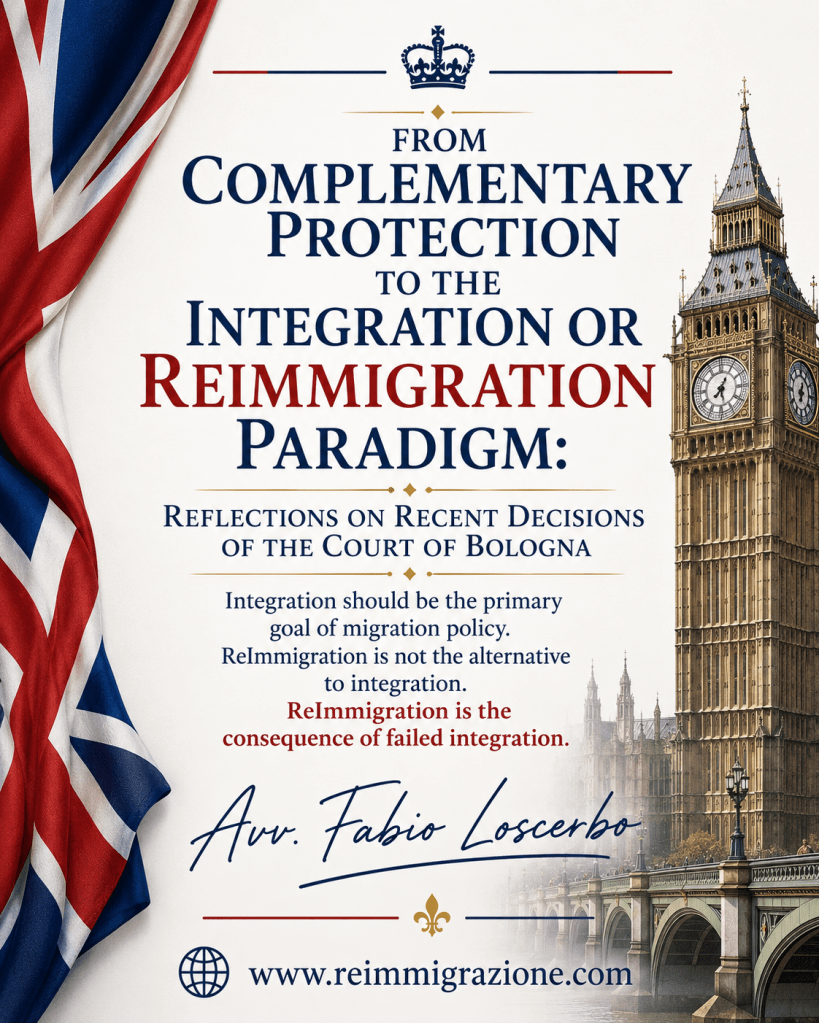
The decisions issued by the Court of Bologna on 22 May 2026 provide an opportunity to reflect on the relationship between immigrant integration and the right to remain in a host country. By granting complementary protection to foreign nationals who had built stable lives in Italy through employment, housing, social relationships and respect for the rules of the host society, these judgments highlight the legal significance of integration. Starting from these cases, this article develops a reflection on the “Integration or ReImmigration” paradigm, according to which continued residence should be assessed not only on the basis of the original reasons for migration, but also on the degree of integration achieved by the individual. From this perspective, ReImmigration is not an alternative to integration, but the consequence of its failure.
For a British audience, the debate on immigration has increasingly become a debate about integration.
Over the past decades, the United Kingdom has experienced significant demographic and cultural change. Immigration has contributed to economic growth, filled labour shortages and transformed many cities and communities. At the same time, questions concerning social cohesion, national identity, community relations and shared values have become central to public discussion.
As a result, the immigration debate in Britain is no longer focused exclusively on border control or the number of arrivals. Increasingly, attention is directed towards what happens after people arrive.
Do newcomers become part of the national community?
Do they share a common civic culture?
Do they participate in society, respect the law and develop a genuine sense of belonging?
These questions are at the heart of the integration debate.
The recent decisions of the Court of Bologna are particularly interesting because they place integration at the centre of legal analysis. The Court granted complementary protection to individuals who had established stable lives in Italy through work, economic independence, housing and social participation. The judges recognised that these individuals had developed meaningful ties with Italian society and that removing them would significantly affect the private and social lives they had built over time.
The importance of these decisions extends beyond the individual cases.
They demonstrate that integration can acquire legal relevance.
Integration is no longer merely a political objective or a social aspiration. It can become a factor that directly influences legal decisions regarding residence and protection.
This observation helps explain the difference between two concepts that are often confused: Remigration and ReImmigration.
In its most radical formulation, Remigration tends to regard return to the country of origin as the general solution to migration-related challenges. The primary objective becomes the reduction of the foreign-born population through return policies.
ReImmigration is based on a different principle.
It does not begin with the assumption that all immigrants should leave.
Nor does it assume that immigration automatically creates a permanent right to remain.
Instead, it asks a simple question:
Has integration actually taken place?
Has the individual learned the language? Does he or she work? Respect the law? Participate in the life of the community? Develop meaningful social ties and a genuine connection with the nation?
If the answer is yes, then integration has produced a result that deserves recognition.
If the answer is no, and there is no meaningful integration or willingness to become part of the host society, then ReImmigration becomes the logical consequence.
This is the key distinction.
Remigration, in its most radical form, places return at the centre of migration policy.
The paradigm of Integration or ReImmigration places integration at the centre of the system. Return is considered only when integration has failed.
This distinction is particularly relevant in the British context.
Many of the challenges discussed in contemporary Britain—community fragmentation, parallel societies, difficulties in social cohesion and debates over national identity—are ultimately questions about integration rather than immigration alone.
The central issue is not merely how many people enter the country.
The central issue is whether immigration leads to successful integration.
The decisions of the Court of Bologna demonstrate that this question is no longer confined to political debate.
It is increasingly influencing legal reasoning as well.
Integration becomes the benchmark.
ReImmigration is not the opposite of integration.
ReImmigration is the consequence of its failure.
Fabio Loscerbo
Lobbyist registered in the European Union Transparency Register – ID 280782895721-36
ORCID: https://orcid.org/0009-0004-7030-0428
“Immigrazione, i dati che raccontano la condizione degli stranieri in Italia” – conoscere i numeri è indispensabile, ma non basta se continuiamo a non misurare l’integrazione
L’articolo di Euronews (consultabile qui: https://it.euronews.com/my-europe/2026/07/24/immigrazione-i-dati-che-raccontano-la-condizione-degli-stranieri-in-italia) offre un quadro statistico della presenza degli stranieri nel nostro Paese: occupazione, redditi, povertà, istruzione, condizioni abitative e altri indicatori che aiutano a comprendere la complessità del fenomeno migratorio. È un contributo utile. Le politiche pubbliche devono partire dai dati, non dagli slogan. Ma proprio leggendo questo tipo di…

“Stefano Feltri: ‘In Italia non c’è un problema sicurezza, il governo fa misure a caso’ – la sicurezza non si misura solo con i reati, ma anche con la qualità dell’integrazione
L’intervento di Stefano Feltri, trasmesso da LA7 e consultabile qui: https://www.la7.it/in-onda/video/stefano-feltri-in-italia-non-ce-un-problema-sicurezza-il-governo-fa-misure-a-caso-24-07-2026-652999, sostiene che in Italia non esisterebbe una reale emergenza sicurezza e che il Governo starebbe adottando misure prive di una strategia coerente. È una riflessione che contiene un elemento condivisibile. Le politiche sulla sicurezza non possono essere costruite sull’emotività del singolo fatto di cronaca.…
LIVE – La ReImmigrazione non è il punto di partenza. È il punto di arrivo.
Dalla diretta YouTube “Integrazione o ReImmigrazione? Il futuro di Italia ed Europa” Quando si sente parlare di ReImmigrazione, il dibattito si concentra quasi sempre sul rimpatrio. È un errore. Nel paradigma che ho proposto, infatti, la ReImmigrazione non rappresenta il punto di partenza della politica migratoria, ma il suo punto di arrivo. Prima viene tutto…



- “Immigrazione, i dati che raccontano la condizione degli stranieri in Italia” – conoscere i numeri è indispensabile, ma non basta se continuiamo a non misurare l’integrazione
- “Stefano Feltri: ‘In Italia non c’è un problema sicurezza, il governo fa misure a caso’ – la sicurezza non si misura solo con i reati, ma anche con la qualità dell’integrazione
- LIVE – La ReImmigrazione non è il punto di partenza. È il punto di arrivo.
- Le droit français peut-il s’inspirer du modèle italien ?
- Il fallimento del modello Lepore: Bologna finanzia l’immigrazione, ma non misura l’integrazione

Lascia un commento