The British debate on asylum is usually dominated by numbers.
How many people cross the Channel? How many are accommodated in hotels? How quickly are asylum claims decided? How many people can ultimately be removed?
A less frequently discussed question may be equally important:
Where should asylum seekers live while Britain decides whether they will be allowed to remain?
On 11 August 2026, The Telegraph reported Andy Burnham’s argument that middle-class areas should also “play their part” in accommodating asylum seekers rather than leaving a disproportionate share of asylum accommodation to less affluent communities.
The proposal is politically contentious, but it raises a genuine policy question.
Britain does not distribute migration in a social vacuum.
Where asylum seekers are accommodated can influence access to schools, healthcare, employment, public transport, language learning and everyday contact with the wider British population.
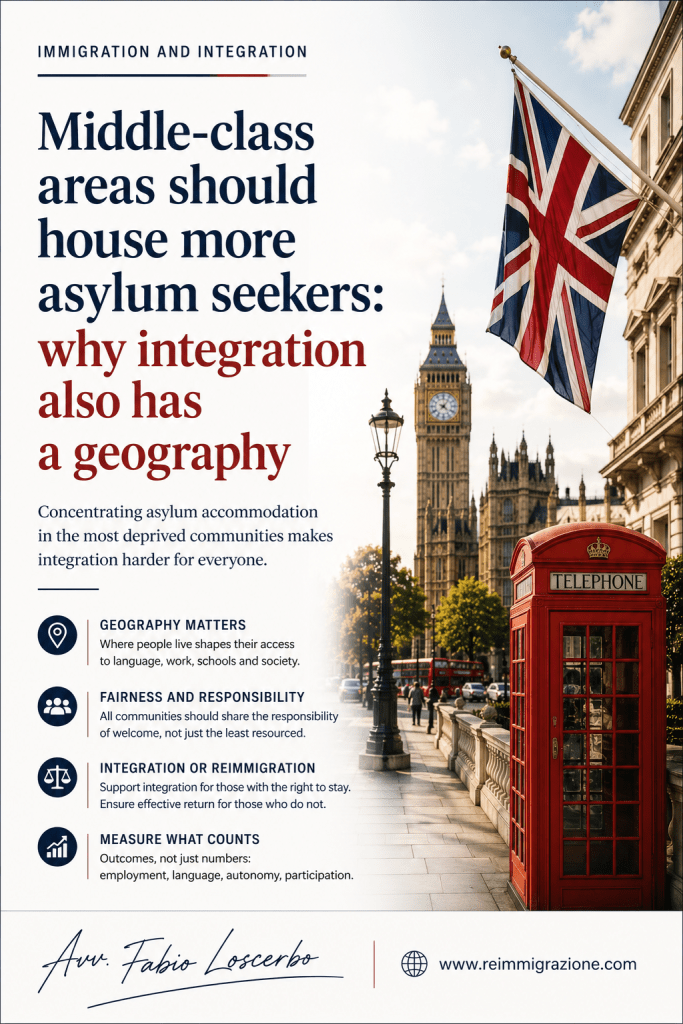
In other words, integration has a geography.
The UK’s asylum support system already includes what is officially called dispersal accommodation: longer-term housing, generally houses and flats within communities, for asylum seekers awaiting the outcome of their cases. Local authorities receive financial support connected to the dispersal system, reflecting the fact that asylum accommodation inevitably creates demands on local services.
Official Home Office statistics show that on 31 March 2026, 20,885 people receiving asylum support — 21 per cent of the supported population — were still living in hotels. A further 72,768 people were living in other forms of accommodation, including dispersal accommodation. Hotel use had fallen significantly from its September 2023 peak, but it remained a substantial part of the system.
The Government has meanwhile been trying to reduce reliance on hotels. In April 2026 it announced that eleven asylum hotels had been closed and presented greater use of large sites, faster asylum decisions, increased removals and stronger enforcement as elements of a broader reform of the asylum system.
Yet replacing hotels does not resolve the underlying geographical question.
If accommodation is disproportionately located where housing is cheapest, Britain may unintentionally place the greatest responsibility for asylum support on communities that already face the greatest economic pressures.
Cheap housing is not necessarily the same thing as good conditions for integration.
Areas suffering from housing shortages, overstretched GP services, limited employment opportunities, struggling schools or high levels of deprivation may have less institutional capacity to absorb sudden population increases.
This does not mean poorer communities are less welcoming.
It means that integration requires infrastructure.
The question should therefore not simply be whether wealthy communities have a moral duty to accept asylum accommodation.
A more useful question is whether Britain would achieve better long-term outcomes through a more balanced geographical distribution.
This is particularly important because concentration can have consequences.
When large numbers of newly arrived migrants are placed in the same neighbourhoods, they may naturally rely on existing ethnic and linguistic networks. Those networks can provide essential support, particularly during the first months after arrival.
But excessive concentration can also reduce opportunities for everyday interaction with the wider society.
Language acquisition may become slower.
Access to employment outside established migrant networks may become harder.
Schools may face sudden additional pressures.
And neighbourhoods can gradually become socially separated from one another.
This is where the debate intersects with a broader migration-policy framework I describe as “Integration or ReImmigration.”
For a British audience, the terminology requires explanation.
ReImmigration is not a programme of collective “remigration”.
It does not propose removing people because they are foreign-born, because of their ethnicity or because of their cultural background.
It begins from a different proposition.
A functioning migration system should distinguish clearly between those who have the right to remain and therefore need an effective route towards integration, and those who, after an individual legal process and all applicable safeguards, have no right to remain and should therefore return.
Between arrival and either of those outcomes lies the integration process.
The State has responsibilities within that process.
It should provide realistic access to language learning, education, employment and lawful accommodation. It should avoid creating conditions that make integration unnecessarily difficult.
Migrants also have responsibilities.
Where a person is permitted to build a future in the country, participation in employment where possible, language acquisition, respect for the law, children’s education and engagement with society should form part of the pathway towards a stable life.
The principle is reciprocal:
the State must make integration possible; the migrant must participate in integration.
That is why geography matters.
A government cannot credibly demand integration while systematically placing people in circumstances that encourage isolation.
If asylum seekers are concentrated in large facilities with little connection to employment, limited public transport and few opportunities to interact with British society, the State itself may be creating barriers to the outcome it says it wants.
Conversely, dispersing people without considering the capacity of local services is not a solution either.
Integration cannot simply mean moving people around a map.
It requires a measure of local integration capacity.
Such a measure could consider housing availability, school capacity, primary healthcare, employment opportunities, public transport, existing migrant concentration, language provision and the number of people already receiving asylum support.
Britain could then ask a more sophisticated question than “where can we find the cheapest accommodation?”
It could ask:
where is successful integration most likely to occur?
This would represent a major change in migration policy.
The same principle applies after the asylum decision.
If a person is recognised as a refugee or otherwise granted the right to remain, the objective should be to move rapidly from temporary asylum accommodation towards ordinary life: employment, stable housing, education and participation in society.
The purpose of asylum accommodation should not be to create a semi-permanent parallel system.
It should be a temporary stage.
But temporary status must genuinely be temporary in both directions.
If an asylum claim is ultimately rejected and no other legal ground for residence exists, removal should be capable of taking place after all judicial safeguards have been respected.
This is the second side of the Integration or ReImmigration model.
Integration for those who have a future in Britain; lawful and effective return for those who do not have a right to remain.
The two principles are not contradictory.
Indeed, they reinforce one another.
A State that cannot return people with no legal basis to remain loses credibility when it asks the public to support substantial investment in migration and integration.
Equally, a State that focuses exclusively on removals while failing to integrate those who are lawfully entitled to remain creates permanent social fragmentation.
A sustainable migration policy therefore needs both.
Britain’s existing dispersal debate illustrates the practical difficulty.
Portsmouth City Council announced in November 2025 that it had secured assurances that no additional homes in the city would be used for asylum dispersal accommodation, arguing that Portsmouth was already hosting more than its fair share while facing its own housing pressures.
The Local Government Association has also called for a better and properly funded system for accommodating and supporting asylum seekers, emphasising the importance of cooperation between central and local government.
These disputes show that geographical distribution cannot be treated simply as an administrative exercise.
A town may technically possess another available building while no longer possessing the social or institutional capacity to absorb additional demand successfully.
This distinction should become central to British migration policy.
Accommodation capacity is not the same as integration capacity.
Burnham’s argument therefore raises a question larger than the immediate political dispute about asylum hotels.
If affluent areas systematically avoid asylum accommodation while poorer areas receive a disproportionate share, Britain risks creating a migration system in which those communities with the fewest resources are expected to perform the most difficult integration work.
A more balanced model should seek to distribute not only people, but responsibility.
This need not mean imposing identical numbers on every neighbourhood.
Different areas have different housing markets, employment structures, schools and public services.
But it does mean that social and economic capacity should become part of the calculation.
The long-term objective should be a migration system capable of measuring more than arrivals.
It should measure outcomes.
Employment.
Language.
Educational participation.
Economic independence.
Housing stability.
Respect for the law.
Social participation.
And, crucially, the relationship between these outcomes and the places in which migrants have been asked to build their lives.
That is the underlying principle of Integration or ReImmigration.
Migration policy should not end at the border.
It should ask what happens after arrival.
Those who have the right to stay should be given a realistic opportunity to become part of Britain.
Those who do not have that right, after due process, should return.
And between those two outcomes, the State should design an integration system that does not undermine itself through geographical segregation.
The question is therefore not only how many asylum seekers Britain can accommodate.
It is where Britain can genuinely integrate them.
That distinction may prove far more important than the number of hotel rooms available on any given day.
Avv. Fabio Loscerbo
Lawyer admitted to practise before the Italian Court of Cassation
Registered in the Register of Interest Representatives of the Italian Chamber of Deputies in the field of Immigration
Lobbyist – EU Transparency Register No. 280782895721-36
ORCID 0009-0004-7030-0428
Stati Uniti, chiedere asilo diventa una prova d’inganno: verso la revoca di 200.000 visti
Il Dipartimento di Stato americano si prepara a revocare, su base progressiva, i visti turistici e d’affari B1 e B2 di un numero potenzialmente vicino a 200.000 stranieri che, dopo essere entrati negli Stati Uniti, hanno presentato domanda d’asilo. La misura, rivelata il 24 agosto dall’Associated Press sulla base di documenti interni e confermata nelle…

Bologna è davvero integrata? I dati quartiere per quartiere
Bologna si presenta come una città accogliente, interculturale e capace di includere una popolazione sempre più diversificata. Ma l’integrazione non può essere valutata soltanto attraverso dichiarazioni politiche, progetti finanziati o iniziative simboliche. Deve essere verificata osservando come la popolazione si distribuisce sul territorio, quali differenze economiche emergono e se alcune zone della città concentrano in…
Cinque Paesi UE guardano al modello Albania. Ma prima dei rimpatri l’Europa deve superare la visione economicista dell’immigrazione
Carlo Fidanza, capodelegazione di Fratelli d’Italia al Parlamento europeo, ha dichiarato oggi, 24 agosto 2026, che cinque Stati membri dell’Unione europea, oltre all’Italia, stanno lavorando a progetti ispirati al modello Albania, con l’obiettivo di realizzare in Paesi terzi strutture destinate alle pratiche, all’identificazione e all’espulsione degli immigrati irregolari. È un segnale politico importante: ciò che…



- Stati Uniti, chiedere asilo diventa una prova d’inganno: verso la revoca di 200.000 visti
- Bologna è davvero integrata? I dati quartiere per quartiere
- Cinque Paesi UE guardano al modello Albania. Ma prima dei rimpatri l’Europa deve superare la visione economicista dell’immigrazione
- Papa Leone: «Prima dei confini ci sono le persone». Ma proprio le persone chiedono che l’immigrazione sia governata
- L’integrazione non può essere presunta: deve essere verificata

Lascia un commento