In the wake of the latest European Parliament elections, immigration has returned to the centre of political debate across the continent. Yet what is emerging is not merely a clash of policy preferences, but a deeper structural divide between two competing models: remigration and what can be defined as Reimmigration.
For a UK audience, this distinction is particularly relevant. The United Kingdom, especially in the current political climate marked by the rise of parties such as Reform UK, is grappling with similar tensions between political demands for stricter migration control and the legal constraints that inevitably shape what can actually be implemented.
The concept of remigration, as it has developed in continental Europe, is rooted in a specific theoretical framework: the idea of “ethnic replacement”, widely discussed in France as the Grand Remplacement. According to this theory, migration leads to a gradual transformation of the demographic and cultural composition of European societies, which in turn justifies policies aimed at encouraging or enforcing the return of migrants to their countries of origin.
What defines remigration is its collective nature. It does not primarily focus on the individual legal position of a person, but on broader societal considerations. It approaches migration as a structural issue requiring equally structural responses.
This is precisely where the legal difficulty arises.
Even outside the European Union, the United Kingdom remains deeply embedded in a legal framework shaped by the European Convention on Human Rights, incorporated domestically through the Human Rights Act 1998. Article 8 ECHR, which protects the right to private and family life, requires that any removal decision be assessed individually, taking into account the specific circumstances of the person concerned.
Moreover, UK courts have consistently emphasised proportionality and case-by-case assessment in immigration matters. This means that broad, generalised policies targeting categories of people—rather than individuals—would face significant legal challenges.
In this context, remigration appears as a politically powerful concept, but one that lacks a clear and viable legal pathway.
This is where the model of Reimmigration becomes relevant.
Reimmigration operates on an entirely different basis. It is not concerned with identity or origin, but with conduct and integration. It does not seek to redefine who belongs to the national community, but to establish clear, legally grounded criteria under which a person may remain.
Under this model, the right to stay is not unconditional. It is contingent upon a demonstrable process of integration, assessed through objective elements such as employment, language proficiency, compliance with the law, and social participation.
At the same time, where these conditions are absent or lost, the legal basis for remaining may also fall away—subject, always, to due process and proportionality.
The distinction is fundamental. While remigration is built on collective assumptions, Reimmigration is grounded in individual legal relationships. It is therefore capable of operating within the framework of existing law, rather than in tension with it.
Recent political developments in France, Germany and the United Kingdom itself illustrate a broader trend: immigration is no longer treated as a temporary or emergency issue, but as a structural question requiring long-term solutions.
The risk, however, is that political narratives move faster than legal systems can accommodate. Remigration offers a clear and immediate political answer, but one that struggles to translate into enforceable law. Reimmigration, by contrast, may appear less radical, but provides a legally sustainable model capable of balancing control with rights.
The key issue is not whether migrants should stay or be removed. The real question is under what legal conditions such decisions are made, and whether those conditions can withstand judicial scrutiny.
In this respect, the European—and increasingly British—debate stands at a crossroads. Remigration remains a political idea in search of legal grounding. Reimmigration represents an attempt to build that grounding within the rule of law.
Avv. Fabio Loscerbo
Lobbyist – EU Transparency Register n. 280782895721-36
ORCID: https://orcid.org/0009-0004-7030-0428
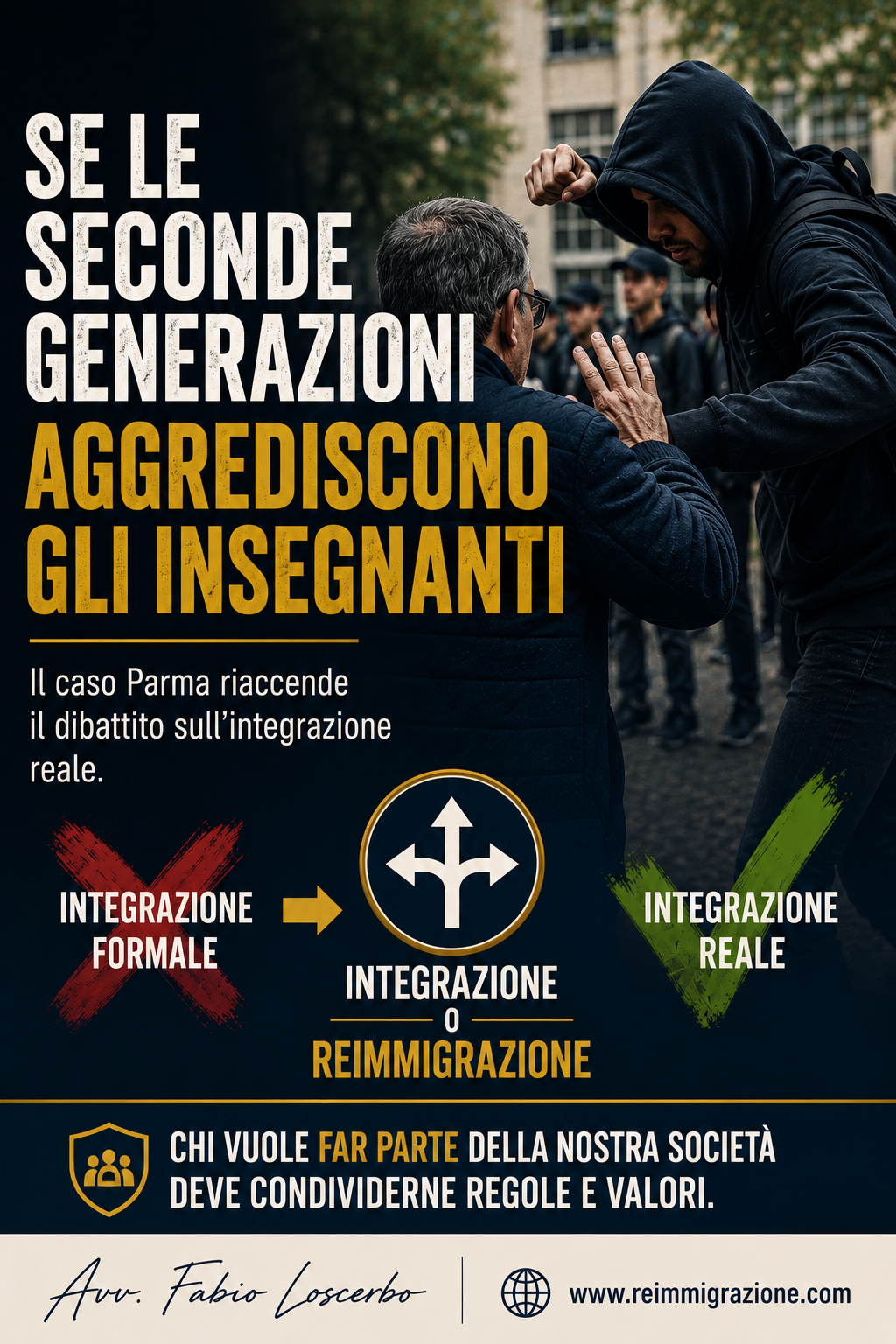
Le seconde generazioni sono davvero integrate?
Negli ultimi giorni due notizie hanno riacceso il dibattito sull’integrazione in Italia e in Europa. La prima è l’articolo pubblicato dal Corriere della Sera il 19 maggio 2026, intitolato “Il contagio della violenza: quando il terrorismo diventa modello”. L’analisi evidenzia come alcuni episodi di violenza contemporanea sembrino riprodurre linguaggi, simboli e modalità operative tipiche del…

Chi cita Algeria e Libia per sostenere la remigrazione non sta parlando del paradigma Integrazione o ReImmigrazione
Abstract Nel dibattito contemporaneo sulle politiche migratorie vengono frequentemente richiamati i casi dell’Algeria post-indipendenza e della Libia successiva alla rivoluzione del 1969 come esempi storici a sostegno della remigrazione. Tale impostazione presenta tuttavia una duplice criticità. In primo luogo, i fenomeni verificatisi in Algeria e Libia furono processi di decolonizzazione e non politiche migratorie nel…

- Complementary Protection and Integration: Why “Integration or ReImmigration” Is Different from “Remigration”
- Le seconde generazioni sono davvero integrate?
- Chi cita Algeria e Libia per sostenere la remigrazione non sta parlando del paradigma Integrazione o ReImmigrazione
- Orden de la Corte Suprema de Casación italiana número 13955 del 13 de mayo de 2026: la “protección complementaria” y el nuevo equilibrio entre integración y expulsión
- Protección complementaria e integración: por qué «Integración o ReImmigration» no es «remigración»

Lascia un commento