The decision issued by the Court of Bologna on 19 February 2026 is not merely a development within Italian law; it reflects a broader shift that is highly relevant for the wider European legal landscape, including the United Kingdom.
At first glance, the case concerns “complementary protection”, a form of legal safeguard granted to individuals who do not qualify for refugee status but whose removal would result in a violation of fundamental rights. However, a closer reading shows that the real significance of the ruling lies elsewhere.
The Court effectively redefines the legal basis of the right to remain. It is no longer grounded solely in the conditions of the country of origin, but increasingly linked to the individual’s level of integration within the host society.
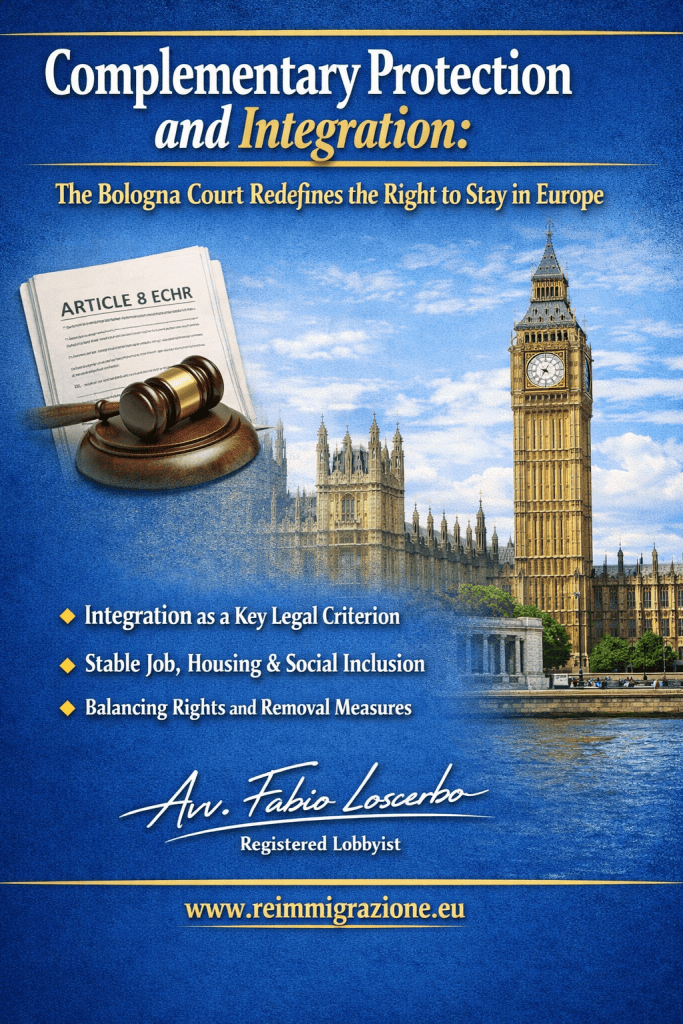
The legal reasoning builds upon a well-established principle in European human rights law: the right to respect for private and family life under Article 8 of the European Convention on Human Rights. This principle, which continues to influence UK jurisprudence even in the post-Brexit context, is here applied in a particularly structured and operational way.
The Court moves away from abstract or purely humanitarian considerations. Instead, it adopts a concrete, evidence-based approach. Integration is treated as a measurable legal criterion.
In the case at hand, several objective factors were decisive: a permanent employment contract, stable income, independent accommodation, language proficiency, participation in training programmes, and the absence of criminal convictions. These elements demonstrate a genuine and consolidated integration into Italian society.
The legal conclusion is straightforward: the stronger the integration, the more disproportionate a removal measure would be in relation to the individual’s right to private life.
This approach is particularly relevant for the United Kingdom.
UK immigration law has long relied on Article 8 ECHR in assessing private and family life claims, especially in cases involving long residence, family ties, or established social connections. However, the Bologna decision offers a more structured model: integration is not merely one factor among many, but a central, determinative element.
This aligns with what can be described as the paradigm of Integration or ReImmigration.
In practical terms, the right to remain is no longer seen as a passive consequence of presence, but as the outcome of an active process of integration. Conversely, where such integration is absent, removal may be justified, provided that it does not result in a disproportionate interference with fundamental rights.
This model offers a way out of the traditional tension between human rights protection and migration control. It introduces a rule-based, evidence-driven assessment, capable of reconciling individual rights with state sovereignty.
For the UK system, the implication is clear. The debate should not be framed solely in terms of admission versus removal, but rather in terms of measurable integration.
The Bologna ruling points towards a future in which the right to stay is not simply granted or denied, but legally constructed on the basis of real and demonstrable integration into society.
Avv. Fabio Loscerbo
Registered Lobbyist in the EU Transparency Register – ID 280782895721-36
ORCID: https://orcid.org/0009-0004-7030-0428

Lascia un commento