In much of the Western debate about immigration, attention tends to focus on border control, asylum policies, and humanitarian obligations. These issues are important, but they often overshadow a deeper structural challenge facing many European countries: demographic decline and the long-term sustainability of welfare systems.
Italy provides a particularly clear example of this transformation.
According to demographic projections published by Eurostat, several European countries will experience a significant reduction in their working-age population in the coming decades. Italy is among the most affected. Estimates published in 2025 indicate that the population aged between 15 and 64 could decline by roughly seven percent by 2035.
National projections produced by Istituto Nazionale di Statistica suggest that the reduction could even exceed eight percent.
In practical terms, this means Italy could lose approximately 1.2 million workers within the next decade.
For readers in the United States, the implications may be easier to understand if we translate this into the structure of the European welfare state. Unlike the U.S. system, many European countries rely heavily on tax-financed social programs that include universal healthcare, extensive pension systems, and large public welfare structures. These systems depend on a relatively stable ratio between workers and retirees.
When the working population shrinks while the elderly population grows, the financial balance becomes increasingly fragile.
Migration is often described as a potential solution to demographic decline. In principle, immigration can indeed help stabilize the labor force. However, the outcome depends largely on a crucial variable: integration into the labor market.
If immigrants are able to find stable employment and contribute to the tax base, they can strengthen the economic system. If integration into the labor market remains weak, the fiscal consequences can move in the opposite direction.
Economic analyses published by Banca d’Italia have examined scenarios in which large groups of immigrants remain only marginally integrated into the workforce. In such cases, the cumulative costs of social assistance, healthcare services, and security policies can grow significantly over time.
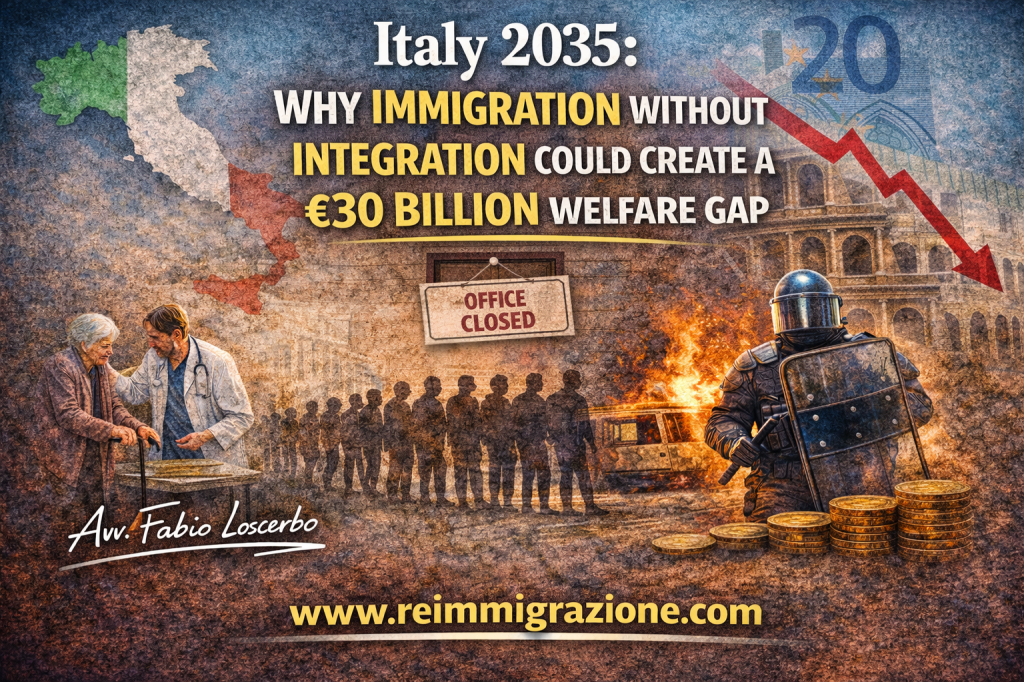
Under these conditions, projections indicate that Italy could face an annual fiscal impact approaching €25–30 billion by 2035.
A large portion of this pressure would derive from healthcare and welfare expenditures, while additional costs would be associated with urban policy and public safety measures in areas characterized by persistent social marginalization.
These dynamics are not unique to Italy. Other European countries have already confronted similar challenges. Sweden, for example, has invested substantial public resources in policies addressing so-called “vulnerable areas,” urban districts where labor market integration and social cohesion remain weak.
The key point is therefore not immigration itself.
The central issue is whether immigration policy is linked to a clear expectation of integration.
For decades, many European migration systems operated on an implicit assumption: once people entered the country, their presence would gradually become permanent. Integration was viewed as a policy objective but rarely as a legal requirement tied to continued residence.
This assumption is increasingly being questioned.
In Italy, one legal framework already reflects a different logic. The system of complementary protection within Italian immigration law requires authorities to evaluate concrete indicators of social and economic integration, such as employment and community ties.
This principle introduces an important idea: integration is not presumed—it must be demonstrated.
From this perspective emerges the paradigm that I describe as “Integration or ReImmigration.”
The concept is based on a simple principle of mutual responsibility between the state and the individual entering its territory. The state provides opportunities for integration—access to employment, language education, and participation in social life. In return, the individual is expected to pursue a genuine path toward integration.
If that process does not occur within a reasonable timeframe, the legal system should allow mechanisms for return to the country of origin.
One possible policy instrument would be a strengthened integration contract, subject to evaluation after approximately two years. If clear indicators of integration—such as stable employment, language proficiency, and respect for basic civic norms—are absent, the residence status could expire.
Such a mechanism should not be interpreted as punitive. Rather, it would function as a governance tool aimed at preserving the long-term sustainability of the welfare state.
The alternative is to continue managing immigration without clear integration criteria. In that scenario, the risks extend beyond fiscal concerns. They may also include social fragmentation, persistent marginalization, and declining trust in public institutions.
The real question facing Italy—and increasingly other Western societies—is therefore not whether immigration should occur.
The fundamental question is whether immigration produces real economic and social integration.
A country that is aging rapidly and that could lose more than a million workers within a decade cannot easily sustain a migration model that fails to generate meaningful participation in its economy and society.
From this perspective, the paradigm Integration or ReImmigration should not be understood as an ideological position. It is a pragmatic reflection on how democratic states might manage migration in the context of profound demographic change.
Avv. Fabio Loscerbo
Lawyer – Registered Lobbyist in the European Union Transparency Register
ID 280782895721-36
ORCID: https://orcid.org/0009-0004-7030-0428

Lascia un commento