For many years, immigration law in Italy — as in much of Europe — was primarily structured around border control, asylum procedures, and the distinction between legal and illegal immigration. Public debate usually focused on how many migrants could enter the country, how asylum claims should be processed, and how irregular migrants should be removed.
Today, however, Italy appears to be moving toward a different legal and political model, one that may be difficult for an American audience to immediately understand because it does not perfectly correspond either to the U.S. asylum system or to traditional European humanitarian protection frameworks.
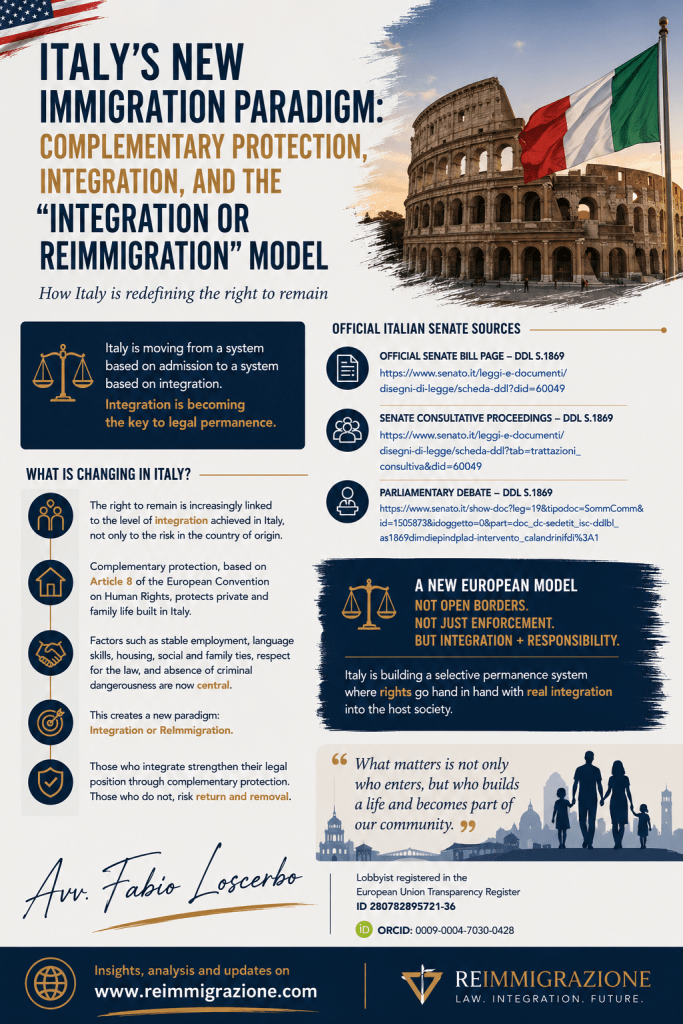
At the center of this transformation is a concept increasingly emerging in Italian parliamentary debate: “complementary protection.”
The issue is particularly visible in the debate surrounding Italy’s “Security Bill” S.1869 currently under discussion before the Senato della Repubblica Italiana.
Official Italian Senate sources regarding Bill S.1869:
https://www.senato.it/leggi-e-documenti/disegni-di-legge/scheda-ddl?did=60049
To understand why this matters, Americans should first understand that Italian immigration law traditionally distinguished between international protection — refugee status and subsidiary protection under European asylum law — and a broader humanitarian framework developed under domestic constitutional and human-rights principles.
What is now evolving is something more complex. Italy is gradually building a system in which the right to remain in the country is increasingly linked not only to danger in the migrant’s home country, but also to the level of integration achieved inside Italy itself.
This is where “complementary protection” becomes crucial.
Unlike classical asylum protection, complementary protection increasingly revolves around Article 8 of the European Convention on Human Rights, which protects private and family life. In practical terms, Italian authorities and courts are progressively evaluating whether a migrant has built a real life inside Italian society.
The analysis is no longer limited to asking: “Would this person face persecution if returned home?”
The system increasingly asks another question: “What would be destroyed if this person were removed from Italy?”
This shift has major consequences. Employment stability, language knowledge, housing, social ties, family relationships, economic self-sufficiency, and absence of criminal dangerousness are becoming central legal elements in evaluating whether a migrant should remain in the country.
For an American audience, the closest comparison might be the gradual emergence of a form of “integration-based immigration legitimacy.” But the Italian model goes further because it directly connects integration to human-rights balancing under European law.
This is the context in which the paradigm “Integration or ReImmigration” emerges.
The idea is not simply mass deportation, nor unrestricted immigration. Instead, it is the construction of a selective permanence model. Under this approach, migrants who genuinely integrate into Italian society progressively strengthen their legal position through complementary protection and Article 8 ECHR protections. Those who fail to integrate, develop no meaningful ties, and remain outside the social framework increasingly fall into the category of return and removal policies.
In this sense, the Italian debate is gradually moving beyond the traditional left-versus-right immigration framework familiar in the United States. The core issue is becoming neither open borders nor simple enforcement, but rather the relationship between integration and legitimacy of permanence.
This may ultimately represent one of the most important transformations currently occurring in European immigration law.
Italy appears to be moving from an immigration system centered primarily on admission into the territory toward a system increasingly centered on the quality of integration achieved within the national community.
Complementary protection is becoming the legal mechanism through which this transformation is taking place.
And Article 8 of the European Convention on Human Rights is becoming the central balancing tool between state sovereignty, immigration control, and the migrant’s right to maintain the life already built inside the host country.
For American observers, this development is important because it may represent the emergence of a distinctly European model of immigration governance: neither unconditional inclusion nor purely enforcement-based removal, but a permanence system increasingly tied to measurable integration within the host society.
Fabio Loscerbo, Attorney at Law
Lobbyist registered in the European Union Transparency Register – ID 280782895721-36
ORCID: https://orcid.org/0009-0004-7030-0428
La scuola come sensore sociale: un patto educativo per le seconde generazioni
La scuola è il luogo nel quale l’integrazione diventa visibile prima che altrove. È nelle classi, nei rapporti con le famiglie, nella frequenza, nel rendimento e nella partecipazione alle attività educative che emergono i progressi, ma anche le difficoltà più profonde. Nel territorio di Malalbergo, la presenza di alunni con cittadinanza non italiana è ormai…

Dubai porta alla frontiera ciò che www.reimmigrazione.com aveva previsto: l’immigrazione sarà governata dagli algoritmi
Dubai sta trasformando il controllo dell’immigrazione in un procedimento sempre più rapido, automatizzato e apparentemente invisibile. Nei primi sei mesi del 2026, i sistemi digitali gestiti dalla General Directorate of Identity and Foreigners Affairs avrebbero trattato oltre 9,4 milioni di viaggiatori. La maggior parte ha utilizzato gli Smart Gates, mentre più di 439 mila persone…
A Padova la conferenza “ReImmigrazione – Quale futuro per l’identità europea?”
Sabato 10 ottobre 2026, alle ore 15:00, si terrà a Padova, in via Piovese 140, la conferenza “ReImmigrazione – Quale futuro per l’identità europea?”, con gli interventi di Lamberto Rimondini e dell’Avvocato Fabio Loscerbo. L’incontro affronterà uno dei temi più delicati del nostro tempo: il rapporto tra immigrazione, integrazione e identità europea. Al centro del…


- La scuola come sensore sociale: un patto educativo per le seconde generazioni
- Dubai porta alla frontiera ciò che www.reimmigrazione.com aveva previsto: l’immigrazione sarà governata dagli algoritmi
- A Padova la conferenza “ReImmigrazione – Quale futuro per l’identità europea?”
- Il modello Albania può funzionare solo misurando l’integrazione: la ReImmigrazione comincia prima del rimpatrio
- La Spagna rivendica politiche migratorie progressiste. Ma regolarizzare non significa integrare

Lascia un commento