In the United Kingdom, the debate on immigration often revolves around border control, labour shortages and the pressure on public services, particularly the National Health Service (NHS). Across Europe, however, a broader discussion is emerging about how immigration, integration and the sustainability of welfare systems are interconnected. In this context, Italy represents an important case study that may also be relevant for British observers.
Understanding the Italian situation helps illustrate how demographic change and migration policies can influence the long-term functioning of public institutions.
Italy operates a universal public healthcare system known as the Servizio Sanitario Nazionale (SSN). Established in 1978, the system guarantees access to healthcare services to all residents and is largely financed through general taxation. In many respects, it resembles the philosophy of the NHS: healthcare is treated not as a market commodity but as a public service intended to ensure social cohesion and equal access to care.
This principle is anchored in Article 32 of the Italian Constitution, which recognises the protection of health as both an individual right and a collective interest. The Italian healthcare system therefore plays a central role not only in medical care but also in the stability of the country’s social model.
At the same time, Italy is undergoing a profound demographic transformation.
The country has one of the oldest populations in Europe. Birth rates are extremely low and the working-age population continues to decline. In this context, immigration has partially offset demographic contraction. According to data from the Italian National Institute of Statistics (ISTAT), around 21.8 per cent of children born in Italy in 2024 had at least one foreign parent. Without this demographic contribution, the country’s population decline would be even more pronounced.
For this reason, immigration is often described as a structural component of Italy’s demographic balance.
However, the key challenge is not only demographic. The sustainability of public institutions depends significantly on the level of integration of the population that uses these services.
Healthcare systems function effectively when patients understand how they operate. Language barriers and limited familiarity with administrative procedures can create inefficiencies. Preventive care becomes less effective, emergency departments may be used instead of primary care, and medical procedures can be repeated unnecessarily because of communication difficulties between patients and healthcare professionals.
In other words, the central issue is not immigration itself but the absence of effective integration mechanisms.
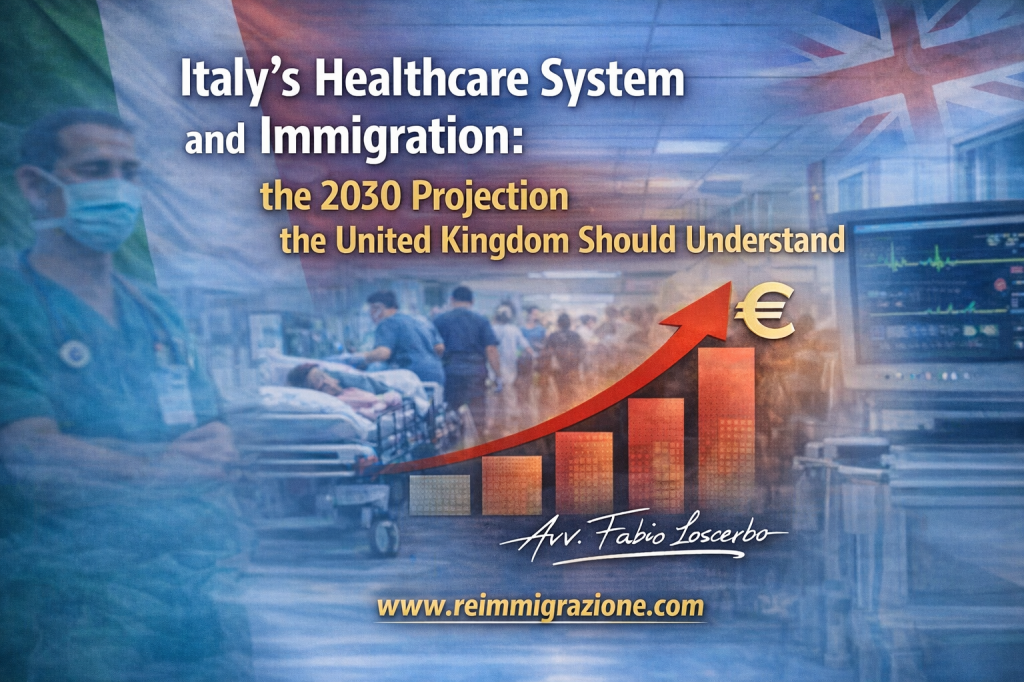
Several projections based on demographic data from Eurostat, economic forecasts from the Bank of Italy, and trends in healthcare expenditure suggest that the interaction between population ageing and segments of the migrant population that remain insufficiently integrated could lead to a cumulative increase in healthcare spending of between 9 and 11 billion euros in Italy between 2026 and 2030.
These projections do not imply that immigrants are responsible for rising healthcare costs. Rather, they highlight a structural problem: when integration policies are weak, public systems tend to operate less efficiently.
Italy is not alone in facing this challenge. Across Europe, governments are increasingly examining the relationship between migration policy, integration and the sustainability of welfare systems.
In Germany, integration policies place strong emphasis on language acquisition and civic education in order to ensure that newcomers can effectively navigate public institutions. In Sweden, research on so-called “vulnerable areas” has shown that public services, including healthcare, may face higher costs in areas where social integration remains limited.
These European experiences suggest that immigration policy cannot be separated from integration policy.
Within this framework, the concept of “Integration or ReImmigration” has been proposed as a way of analysing migration governance. The idea is based on a simple principle: long-term residence in a host country should rest on three fundamental pillars—participation in the labour market, knowledge of the national language, and respect for the legal and institutional framework of the host society.
Integration should therefore be understood not as an abstract aspiration but as a concrete and measurable policy objective.
Applied to healthcare systems, this approach highlights the importance of linguistic and social integration in improving institutional efficiency. When patients understand the language and the structure of the healthcare system, preventive medicine becomes more effective, communication between doctors and patients improves, and public resources can be used more efficiently.
The objective is not to restrict fundamental rights, but to ensure that public institutions remain sustainable in the long term.
For readers in the United Kingdom, the Italian case provides an interesting perspective on a question that is also relevant to British public debate: how can immigration and integration policies be designed in a way that preserves the stability of public services?
If integration works effectively, immigration can contribute positively to demographic stability and economic vitality. If it fails, the pressure on public systems—particularly healthcare—may gradually increase.
The year 2030 may still appear distant, but the demographic and institutional trends that will shape that future are already visible today.
Avv. Fabio Loscerbo
Attorney at Law – Registered Lobbyist in the European Union Transparency Register
ID 280782895721-36
ORCID
https://orcid.org/0009-0004-7030-0428

Lascia un commento