Welcome to a new episode of the podcast “Integration or ReImmigration”. My name is Fabio Loscerbo, attorney at law.
Italy is currently debating a major immigration reform known as Security Bill 1869. Most public discussion focuses on border controls, detention measures and deportation policies. But a much deeper legal transformation is taking place within the Italian immigration system.
At the centre of this transformation is a legal concept called “complementary protection”.
For a British audience, it is important to understand that this concept does not exactly correspond either to traditional asylum protection or to discretionary humanitarian leave within the UK immigration system. Italy is gradually developing a framework in which the right to remain in the country depends not only on risks in the migrant’s country of origin, but increasingly on the level of integration achieved within Italian society itself.
This means that stable employment, regular income, language knowledge, housing stability, family relationships, social integration, respect for the law and absence of criminal dangerousness are becoming increasingly important in determining whether a migrant may legally remain in Italy.
Article 8 of the European Convention on Human Rights, which protects private and family life, plays a central role in this process. Italian courts are increasingly examining not only whether a migrant may face harm upon return, but also what private and family life has already been built inside Italy and what would be destroyed through removal.
This is where the paradigm “Integration or ReImmigration” emerges.
The concept is neither unrestricted immigration nor indiscriminate mass deportation. Italy appears to be moving towards a selective permanence model. Migrants who genuinely integrate into the national community progressively strengthen their legal position through complementary protection and Article 8 safeguards. Those who fail to integrate or develop no meaningful social ties increasingly fall within the sphere of return and removal policies.
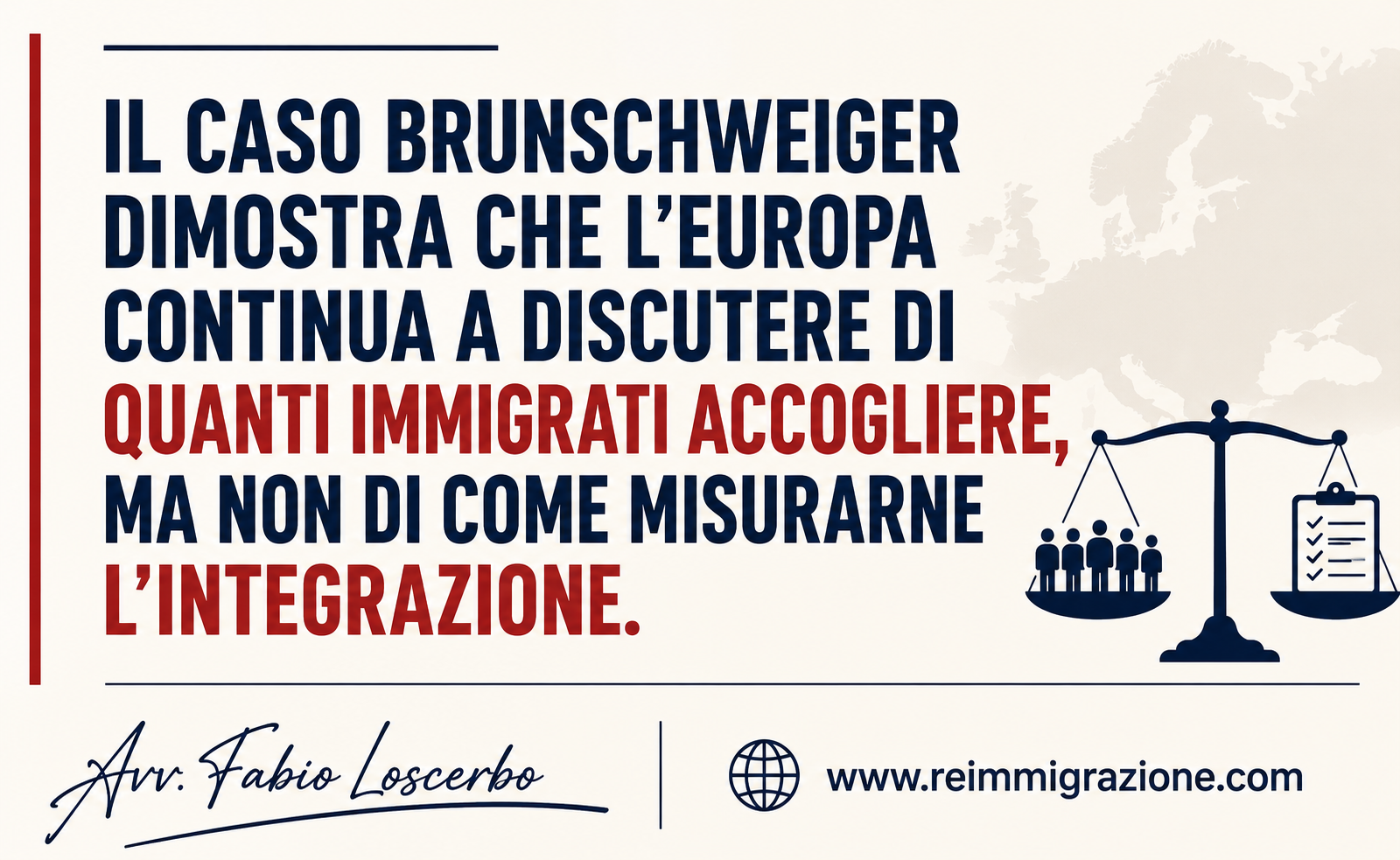
This development may represent one of the most significant transformations currently taking place in European immigration law. The system is gradually evolving from a framework focused mainly on entry and immigration status towards one increasingly centred on integration within the host society.
Complementary protection is becoming the legal mechanism through which this transformation is taking place.
My name is Fabio Loscerbo and this was a new episode of the podcast “Integration or ReImmigration”.

Stati Uniti, chiedere asilo diventa una prova d’inganno: verso la revoca di 200.000 visti
Il Dipartimento di Stato americano si prepara a revocare, su base progressiva, i visti turistici e d’affari B1 e B2 di un numero potenzialmente vicino a 200.000 stranieri che, dopo essere entrati negli Stati Uniti, hanno presentato domanda d’asilo. La misura, rivelata il 24 agosto dall’Associated Press sulla base di documenti interni e confermata nelle…

Bologna è davvero integrata? I dati quartiere per quartiere
Bologna si presenta come una città accogliente, interculturale e capace di includere una popolazione sempre più diversificata. Ma l’integrazione non può essere valutata soltanto attraverso dichiarazioni politiche, progetti finanziati o iniziative simboliche. Deve essere verificata osservando come la popolazione si distribuisce sul territorio, quali differenze economiche emergono e se alcune zone della città concentrano in…
Cinque Paesi UE guardano al modello Albania. Ma prima dei rimpatri l’Europa deve superare la visione economicista dell’immigrazione
Carlo Fidanza, capodelegazione di Fratelli d’Italia al Parlamento europeo, ha dichiarato oggi, 24 agosto 2026, che cinque Stati membri dell’Unione europea, oltre all’Italia, stanno lavorando a progetti ispirati al modello Albania, con l’obiettivo di realizzare in Paesi terzi strutture destinate alle pratiche, all’identificazione e all’espulsione degli immigrati irregolari. È un segnale politico importante: ciò che…

- Stati Uniti, chiedere asilo diventa una prova d’inganno: verso la revoca di 200.000 visti
- Bologna è davvero integrata? I dati quartiere per quartiere
- Cinque Paesi UE guardano al modello Albania. Ma prima dei rimpatri l’Europa deve superare la visione economicista dell’immigrazione
- Papa Leone: «Prima dei confini ci sono le persone». Ma proprio le persone chiedono che l’immigrazione sia governata
- L’integrazione non può essere presunta: deve essere verificata

Lascia un commento