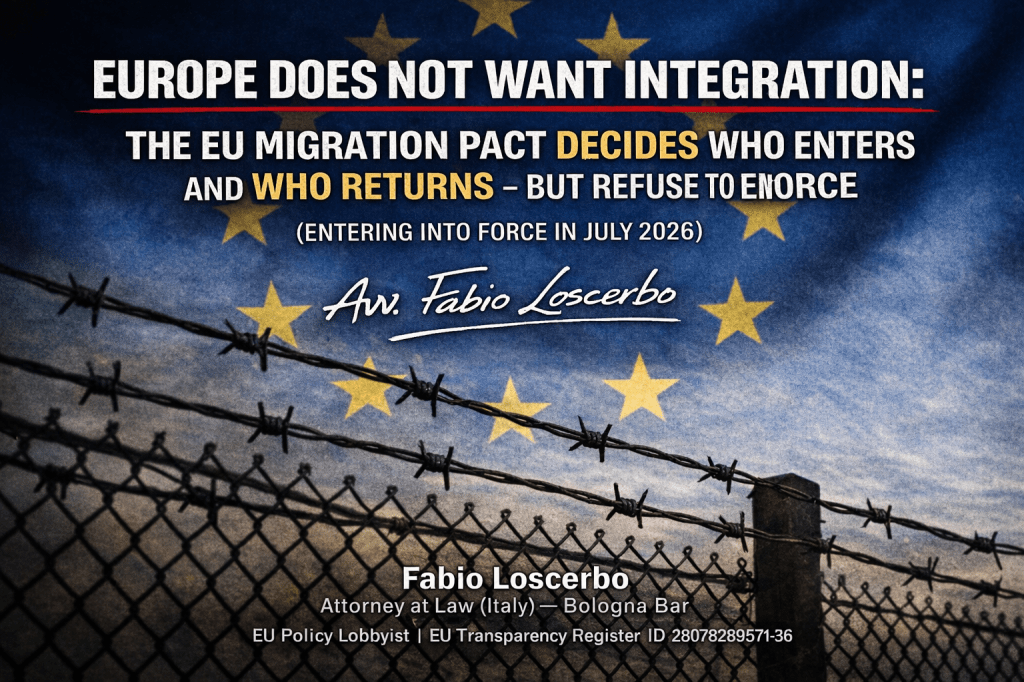
(Entering into force in July 2026)
The new European Union Migration and Asylum Pact, set to fully enter into force in July 2026, is often presented as a long-awaited reform designed to restore order to Europe’s broken asylum system. It is described as pragmatic, balanced, and realistic.
A closer look, however, reveals a fundamental political choice — and a serious flaw.
The Pact strengthens border control, accelerates asylum procedures, expands biometric registration, and makes returns more systematic. What it does not do is just as important: it deliberately avoids imposing integration as a legal obligation on those who are allowed to stay.
This is not an oversight. It is a conscious decision.
From an American perspective, this omission is striking. In the United States, immigration policy — regardless of political orientation — has always been tied to a clear expectation: those who are admitted are expected to integrate, to learn the language, to respect the constitutional order, and to participate economically and civically. Integration is debated, enforced, measured, and sometimes sanctioned.
The European Union, by contrast, has chosen a different path.
The 2026 Pact is highly detailed when it comes to procedures. It regulates who is screened at the border, how quickly claims are processed, how data are stored in centralized databases like Eurodac, and how rejected applicants are returned. Europe has become very efficient at managing files, fingerprints, timelines, and transfers.
But when it comes to what happens after admission, the Pact retreats into ambiguity.
Integration is mentioned only as a policy goal, never as a condition. There is no binding requirement to learn the national language within a defined timeframe. No enforceable obligation of civic integration. No legal consequence attached to persistent non-integration. No connection between long-term residence and demonstrated participation in the host society.
In short, Europe decides who enters and who must leave, but demands nothing from those who remain.
This is not a technical weakness. It is a political contradiction.
The EU has finally acknowledged that unlimited entry is unsustainable and that return policies must work. But it stops short of completing the logic. Without mandatory integration, the system produces a growing population of legal residents who enjoy rights without corresponding, enforceable duties. The result is not inclusion, but fragmentation — parallel communities, social tension, and political backlash.
Ironically, this failure is one of the main drivers behind the rise of “return-first” movements across Europe. When integration is optional and unenforced, public trust in immigration collapses. Citizens stop believing in the system, not because they reject immigration as such, but because they see no mechanism ensuring social cohesion.
From a rule-of-law standpoint, the EU Pact is therefore incomplete.
A serious migration framework rests on three pillars:
control of entry, effective return of those without legal status, and mandatory integration for those admitted. The 2026 Pact adopts the first two and carefully avoids the third.
The message is clear: Europe wants administrative order, not social responsibility. It prefers procedural neutrality over political clarity. But neutrality, in this context, is a choice — and a costly one.
By refusing to define integration as a legal obligation, the EU undermines its own objectives. Borders without integration do not produce stability. Returns without integration do not restore legitimacy. A system that decides who stays but not how one must live once staying is structurally fragile.
The European Union does not say this openly. But the reality is evident:
integration is no longer the core of European migration policy.
And that omission, more than any technical rule, will define the success or failure of the EU Migration Pact after 2026.
Fabio Loscerbo
Attorney at Law (Italy) – Bologna Bar
EU Policy Lobbyist
Registered in the EU Transparency Register
ID 280782895721-36

Lascia un commento