To an American audience, the crisis in Ceuta may look like another distant episode in Europe’s long-running migration debate. It is not. What happened on Spain’s North African frontier raises a question that is also familiar in the United States: what happens when a government’s immigration policy sends a message of openness that its border-control system cannot sustain?
Ceuta is not located on the European continent. It is a Spanish city on the coast of North Africa, surrounded by Morocco and separated from mainland Spain by the Mediterranean Sea. Together with Melilla, it constitutes one of the European Union’s only land borders with Africa. Entry into Ceuta therefore means entry into Spanish territory and, legally and politically, an attempt to enter the European system.
In late July 2026, tens of thousands of people crossed from Morocco into Ceuta within a remarkably short period. The city’s reception system was overwhelmed, Spain deployed military and police personnel, and Prime Minister Pedro Sánchez described the episode as a violation of Spain’s territorial integrity. He blamed human-trafficking organizations for spreading a misleading interpretation of a Spanish Supreme Court ruling concerning immediate returns at the border.
Trafficking networks undoubtedly exist, and no serious migration policy can ignore them. They exploit desperation, circulate false promises and profit from irregular movement. But blaming “the mafias” does not answer the central political question.
Why was Spain suddenly perceived as the easiest gateway into Europe?
Reports from Morocco and international news agencies indicate that social-media videos and word of mouth played a significant role in mobilizing many of those who attempted the crossing. Rumors circulated that a recent Spanish court decision would prevent their immediate return and allow them to remain in Spanish territory. That interpretation appears to have been legally inaccurate: the ruling restricted certain summary removals but did not eliminate ordinary return procedures.
This distinction matters. If thousands of people moved after seeing videos and messages on Instagram and other platforms, then the government cannot simply assume that a sophisticated criminal organization directed the entire operation. The role of traffickers must be established through evidence. It cannot become a convenient explanation used to shield political leaders from scrutiny.
The broader context is Spain’s extraordinary regularization policy.
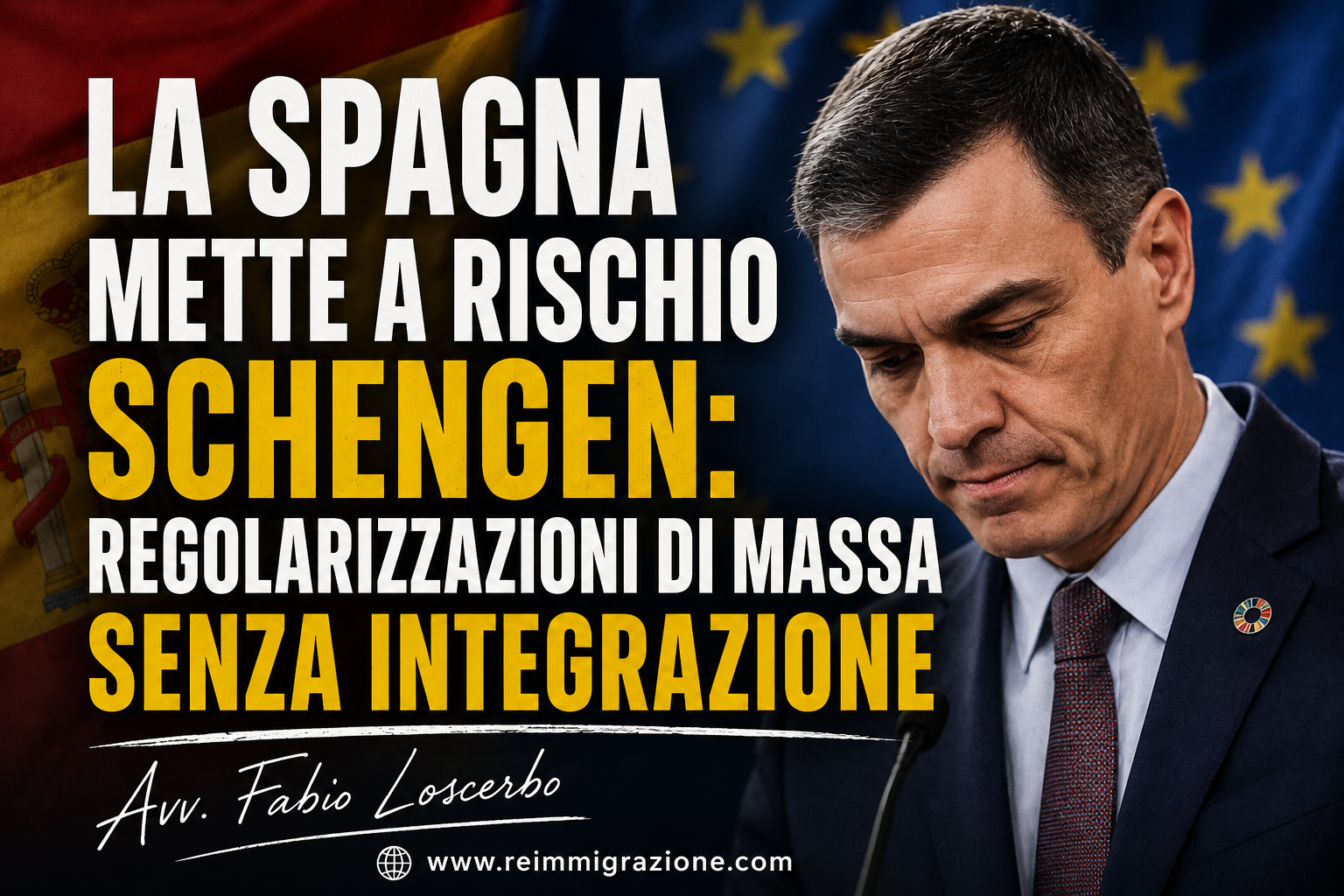
In 2026, the Sánchez government launched a large-scale process allowing substantial numbers of undocumented migrants already present in Spain to seek legal status and employment rights. More than one million applications were reportedly submitted, and by early July over 600,000 applicants had received temporary work authorization while their cases were being processed.
The Spanish government presents this policy as a pragmatic response to labor shortages, demographic decline and the presence of migrants who are already working in the country. Those arguments deserve serious consideration. A state has the right to regularize people who are genuinely integrated, employed and contributing to society.
But a government must also consider the external message produced by its decisions.
Migration policy is not communicated only through statutes, ministerial decrees or official press conferences. It is communicated through simplified messages travelling across borders:
“Spain is regularizing undocumented migrants.”
“Spain is more open than other European countries.”
“Once you enter, you may eventually obtain legal status.”
These messages may be incomplete or distorted. Yet they still influence expectations. In migration policy, perception can be as consequential as the formal content of the law.
Americans understand this phenomenon well. In every U.S. debate over border enforcement, humanitarian parole, asylum processing or legalization, policymakers argue not only about the immediate beneficiaries of a measure but also about the “signal” it may send to potential migrants abroad. The same principle applies in Europe.
A broad regularization does not automatically cause a specific border crossing. The evidence does not justify such a simplistic conclusion. But it is equally unrealistic to claim that a major amnesty has no effect on how a country is perceived beyond its borders.
Sánchez wanted Spain to present itself as the humane exception in an increasingly restrictive Europe. His government emphasized the economic value of immigration while neighboring countries tightened their policies.
That political choice carried consequences.
Spain became vulnerable to the perception that its border was more permeable, its enforcement less decisive and its future regularizations more likely. Whether that perception was accurate is almost secondary. Once it circulated through social media, it became operationally real.
This is why Sánchez bears political responsibility.
He did not organize the movement toward Ceuta. He did not invite any particular person to cross the border. But his government helped create the political environment in which Spain could be represented as Europe’s soft underbelly: the state most willing to tolerate irregular entry and legalize irregular residence afterward.
Now, after the border system was overwhelmed, Sánchez has rediscovered the language of sovereignty, territorial integrity and repatriation.
That reversal exposes the contradiction at the heart of his policy. A state cannot consistently weaken the deterrent effect of its immigration rules and then act surprised when people test its borders. Nor can it defend national sovereignty only after control has already broken down.
Europe needs something more credible than an endless cycle of mass arrivals, emergency deployments and periodic amnesties.
The proper alternative is neither indiscriminate exclusion nor unconditional permanence. It is the principle of Integration or ReImmigration.
Those who work, respect the law, learn the language and build a stable relationship with the host society should have a transparent path toward continued residence and integration. Those who do not qualify to remain, or whose applications are lawfully rejected, must be returned through orderly procedures that respect human dignity and judicial guarantees.
Regularization should reward demonstrated integration, not create the expectation that irregular entry will eventually be forgiven as a matter of political routine.
Sánchez is entitled to investigate and prosecute trafficking organizations. But he cannot use them as an alibi for the effects of his own policy.
The Ceuta crisis was not merely a failure of border surveillance. It was a failure of political coherence. Spain attempted to present itself simultaneously as Europe’s most welcoming destination and as a state capable of defending one of the continent’s most exposed borders.
It cannot credibly be both without strict conditions, effective enforcement and a clear distinction between those who integrate and those who must return.
Pedro Sánchez turned Spain into Europe’s soft underbelly. Blaming the mafias will not erase that responsibility.
Fabio Loscerbo, Attorney at Law
Lobbyist registered in the European Union Transparency Register, No. 280782895721-36, in the field of Migration and Asylum
ORCID: https://orcid.org/0009-0004-7030-0428

Dalla remigrazione alla permanenza condizionata: l’Europa si avvicina alla ReImmigrazione
Per anni il dibattito europeo sull’immigrazione si è diviso tra due impostazioni opposte. Da una parte, la permanenza dello straniero è stata spesso considerata come un processo destinato a consolidarsi progressivamente, quasi per il solo trascorrere del tempo. Dall’altra, la remigrazione è stata proposta come una risposta politica generale, fondata sull’idea di riportare nei Paesi…

Pedro Sánchez a transformé l’Espagne en ventre mou de l’Europe : il se réfugie désormais derrière l’alibi des mafias
Pour le public français, la crise de Ceuta ne doit pas être considérée comme un simple problème intérieur espagnol. Elle concerne directement la France, car Ceuta constitue une frontière extérieure de l’Union européenne et que toute perte de contrôle à l’entrée de l’espace européen finit nécessairement par produire des conséquences sur les autres États membres.…
Il “rechazo en frontera” spagnolo e il respingimento italiano: due modelli a confronto dopo la sentenza del Tribunal Supremo su Ceuta e Melilla
La sentenza n. 814/2026 del 29 giugno 2026, pronunciata dalla Quinta Sezione della Sala del contenzioso amministrativo del Tribunal Supremo spagnolo nel ricorso per cassazione n. 3795/2025, interviene su una questione che, pur essendo strettamente connessa alla particolare conformazione geografica delle città autonome di Ceuta e Melilla, presenta un interesse più generale per tutti gli…


- Dalla remigrazione alla permanenza condizionata: l’Europa si avvicina alla ReImmigrazione
- Pedro Sánchez a transformé l’Espagne en ventre mou de l’Europe : il se réfugie désormais derrière l’alibi des mafias
- Il “rechazo en frontera” spagnolo e il respingimento italiano: due modelli a confronto dopo la sentenza del Tribunal Supremo su Ceuta e Melilla
- Ceuta and Europe’s Border Crisis: Regularization, Illegal Entry, and Political Responsibility
- Cottarelli parla di “buona immigrazione”: ma senza misurare l’integrazione resta soltanto uno slogan

Lascia un commento