Welcome to a new episode of Integration or ReImmigration, I’m immigration lawyer Fabio Loscerbo.
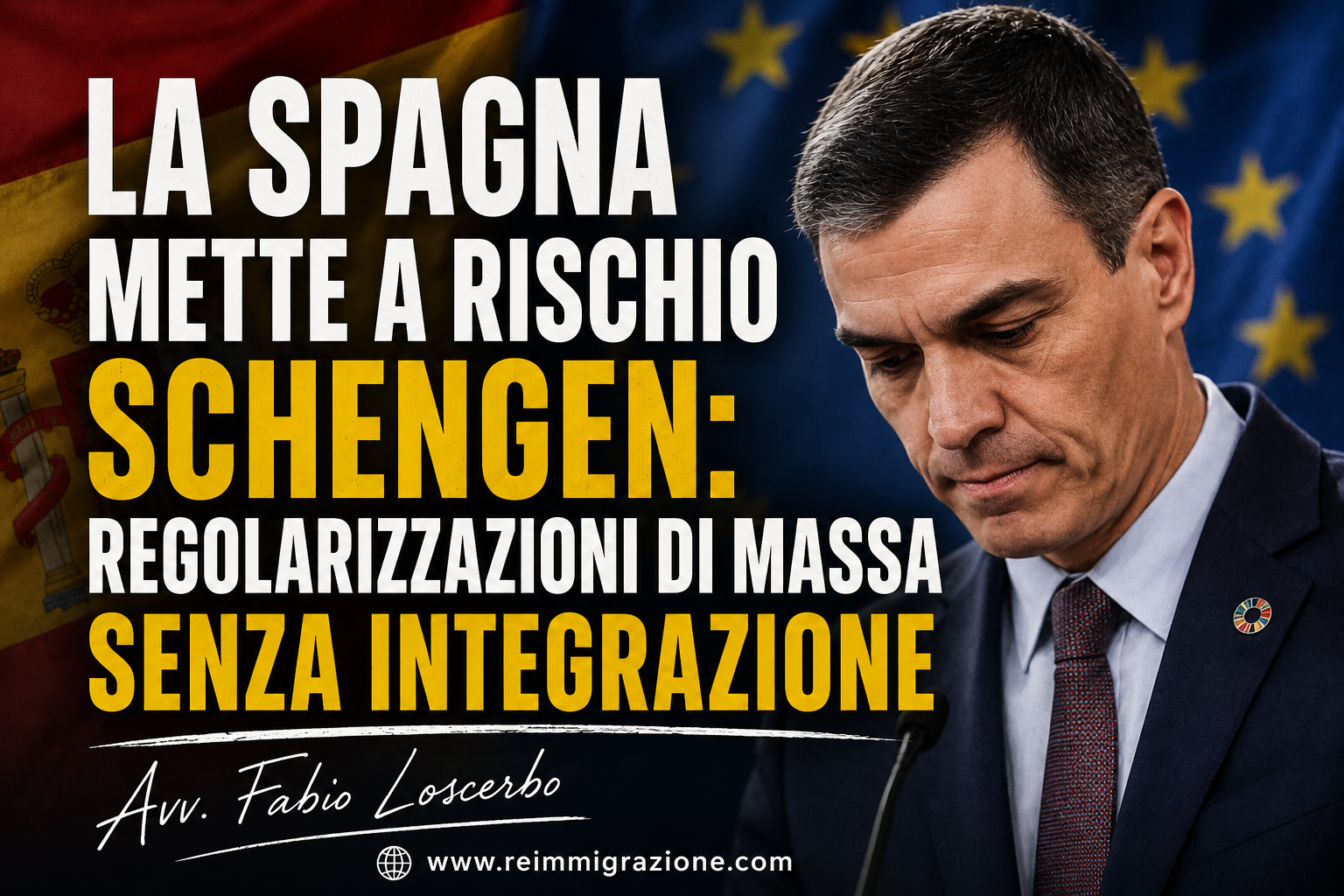
Today I want to speak to an American audience about a debate in Europe that raises broader questions about immigration policy everywhere: Spain’s proposed large-scale regularisation under Prime Minister Sánchez.
Is it a model — or a surrender?
That is the real question.
My point is not that regularisation is always wrong. The question is on what legal basis people are regularised.
If mass legalisation happens without individual assessment of integration, immigration law risks becoming a corrective for policy failure, rather than a framework governed by criteria.
And this is where two models diverge.
One model says: when the system produces irregularity, the answer is broad amnesty.
The other says: legal stability should follow verifiable integration — work, language, compliance with the law, real social ties.
For a U.S. audience, this is close to a familiar debate: broad amnesty versus earned legal presence.
And I argue the second model is stronger.
Because repeated amnesties can become a cycle. But an integration-based standard creates a rule.
That is also where my broader framework — Integration or ReImmigration — comes in.
The principle is straightforward: those who integrate should remain. Where integration fails, return policies remain part of the system.
Not indiscriminate regularisation, but integration as the legal foundation of permanence.
And that is why the Spanish case matters beyond Spain.
It forces a deeper question: should immigration be governed through periodic exceptions, or through durable criteria?
I believe the future lies in criteria.
And that is why I ask: is Spain showing a model — or revealing the limits of the amnesty approach?
Thank you for listening, and I’ll see you in the next episode of Integration or ReImmigration.

Dalla remigrazione alla permanenza condizionata: l’Europa si avvicina alla ReImmigrazione
Per anni il dibattito europeo sull’immigrazione si è diviso tra due impostazioni opposte. Da una parte, la permanenza dello straniero è stata spesso considerata come un processo destinato a consolidarsi progressivamente, quasi per il solo trascorrere del tempo. Dall’altra, la remigrazione è stata proposta come una risposta politica generale, fondata sull’idea di riportare nei Paesi…

Pedro Sánchez a transformé l’Espagne en ventre mou de l’Europe : il se réfugie désormais derrière l’alibi des mafias
Pour le public français, la crise de Ceuta ne doit pas être considérée comme un simple problème intérieur espagnol. Elle concerne directement la France, car Ceuta constitue une frontière extérieure de l’Union européenne et que toute perte de contrôle à l’entrée de l’espace européen finit nécessairement par produire des conséquences sur les autres États membres.…
Il “rechazo en frontera” spagnolo e il respingimento italiano: due modelli a confronto dopo la sentenza del Tribunal Supremo su Ceuta e Melilla
La sentenza n. 814/2026 del 29 giugno 2026, pronunciata dalla Quinta Sezione della Sala del contenzioso amministrativo del Tribunal Supremo spagnolo nel ricorso per cassazione n. 3795/2025, interviene su una questione che, pur essendo strettamente connessa alla particolare conformazione geografica delle città autonome di Ceuta e Melilla, presenta un interesse più generale per tutti gli…


- Dalla remigrazione alla permanenza condizionata: l’Europa si avvicina alla ReImmigrazione
- Pedro Sánchez a transformé l’Espagne en ventre mou de l’Europe : il se réfugie désormais derrière l’alibi des mafias
- Il “rechazo en frontera” spagnolo e il respingimento italiano: due modelli a confronto dopo la sentenza del Tribunal Supremo su Ceuta e Melilla
- Ceuta and Europe’s Border Crisis: Regularization, Illegal Entry, and Political Responsibility
- Cottarelli parla di “buona immigrazione”: ma senza misurare l’integrazione resta soltanto uno slogan

Lascia un commento