Across Europe, debates about migration often focus on immediate political questions: border control, asylum procedures, and the distribution of migrants among EU Member States. These issues dominate the headlines and shape daily political discussion. Yet behind these short-term debates lies a deeper structural challenge that will determine the long-term stability of European societies: demographic decline and the sustainability of the welfare state.
Italy represents one of the clearest examples of this emerging problem.
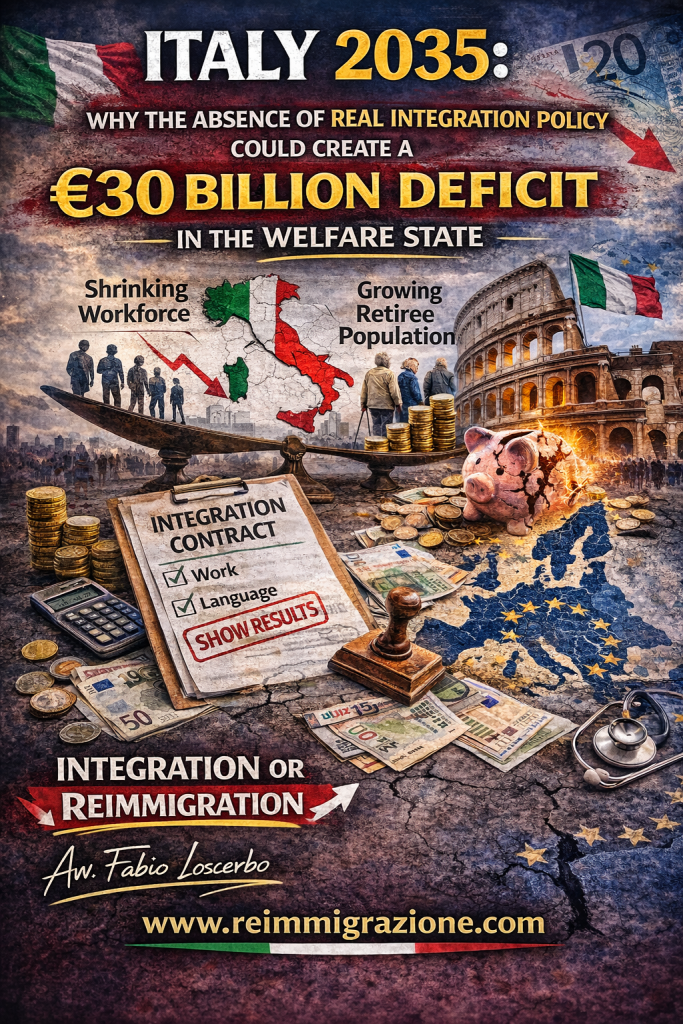
According to demographic projections published by Eurostat, several European countries will experience a significant reduction in the working-age population over the coming decades. Italy is among the countries most exposed to this trend. Estimates published in 2025 suggest that the population aged between 15 and 64 could decline by roughly seven percent by 2035.
National projections from the Istituto Nazionale di Statistica indicate an even stronger contraction, exceeding eight percent.
In practical terms, this means that Italy could lose around 1.2 million active workers within the next decade.
For readers in the United Kingdom, the implications of such demographic change are not difficult to understand. Modern welfare systems—whether in Italy, Britain, or elsewhere in Europe—rely on a basic economic principle: the working population finances pensions, healthcare and social services through taxation and social contributions.
When the number of workers decreases while the number of retirees increases, the balance of the system becomes progressively harder to sustain.
In this context, immigration is frequently presented as a potential solution to demographic decline. In theory, new arrivals can help stabilise the labour market and contribute to public finances.
However, the outcome depends on one crucial factor: the effective economic and social integration of migrants.
If migrants become fully integrated into the labour market, their presence can strengthen the economy and contribute to the sustainability of welfare systems. But when integration remains weak or incomplete, the opposite dynamic may occur: rising expenditure on social support, healthcare, urban policy and public security.
Economic analyses published by the Banca d’Italia suggest that in scenarios where a significant share of migrants remains outside the labour market for extended periods, the fiscal consequences can be substantial.
Under such conditions, Italy could face additional public costs of between €25 and €30 billion per year by 2035.
Part of this expenditure would be linked to welfare and healthcare systems, while another portion would be associated with the management of social marginalisation in certain urban areas.
This is not a uniquely Italian issue. Other European countries have already experienced similar dynamics. In Sweden, for instance, the state has invested considerable public resources in programmes aimed at so-called “vulnerable areas,” where difficulties of integration have become particularly evident.
The core question, therefore, is not immigration itself.
The real issue is whether a clear legal relationship exists between the right to remain in the country and a genuine process of integration.
For many years, European migration policies were implicitly based on the assumption that once an individual entered a country, their presence would gradually become permanent. Integration was considered desirable, but rarely defined as a concrete legal condition for maintaining the right of residence.
Today, this assumption appears increasingly problematic.
In Italy, there is already an interesting legal precedent. The system of complementary protection within Italian immigration law requires authorities to evaluate the actual level of social and economic integration of an individual.
This introduces a crucial principle: integration cannot simply be presumed—it must be demonstrated.
From this observation emerges the paradigm that I define as “Integration or ReImmigration.”
This concept is based on a principle of reciprocal responsibility between the state and the foreign national entering its territory. The state offers opportunities for integration—access to employment, language learning and participation in social life. In return, the individual is expected to engage in a genuine process of integration.
If such integration does not take place within a reasonable period, the legal system should be able to provide mechanisms for return to the country of origin.
One possible approach would be the introduction of a reinforced integration contract, whose results would be evaluated after approximately two years. If clear progress is not achieved—stable employment, language competence and participation in society—the right of residence could cease.
Such a mechanism should not be interpreted as a punitive measure. Rather, it should be understood as a tool of migration governance designed to protect the long-term sustainability of the welfare state.
The alternative would be to continue managing migration without clear criteria for integration. In that case, the risks would extend beyond fiscal pressure: they could also include social fragmentation, urban segregation and declining public confidence in institutions.
For Italy—and increasingly for other European countries—the key question is therefore not simply whether immigration should exist.
The real question is far more fundamental: does immigration actually produce integration?
A country that is ageing rapidly and that could lose more than a million workers within a decade can hardly afford a migration model that fails to generate real economic and social participation.
Seen in this light, the paradigm “Integration or ReImmigration” should not be understood as an ideological proposal, but as a pragmatic reflection on one of the most significant demographic challenges facing contemporary Europe.
Avv. Fabio Loscerbo
Lawyer – Lobbyist registered in the European Union Transparency Register
ID 280782895721-36
ORCID: https://orcid.org/0009-0004-7030-0428

Lascia un commento