Across Europe, immigration policy has increasingly oscillated between two opposing approaches: broader acceptance and humanitarian inclusion on one side, and stricter border enforcement and removals on the other.
Italy, however, now appears to be developing a more complex legal model that may be of particular interest to a British audience, especially in the context of ongoing UK debates around migration control, integration, deportation policy, and the relationship between human rights law and national sovereignty.
At the centre of this Italian transformation is a legal concept becoming increasingly important within parliamentary debate: “complementary protection” (“protezione complementare”).
The issue is especially visible in discussions surrounding Italy’s Security Bill S.1869, currently under examination before the Senato della Repubblica Italiana.
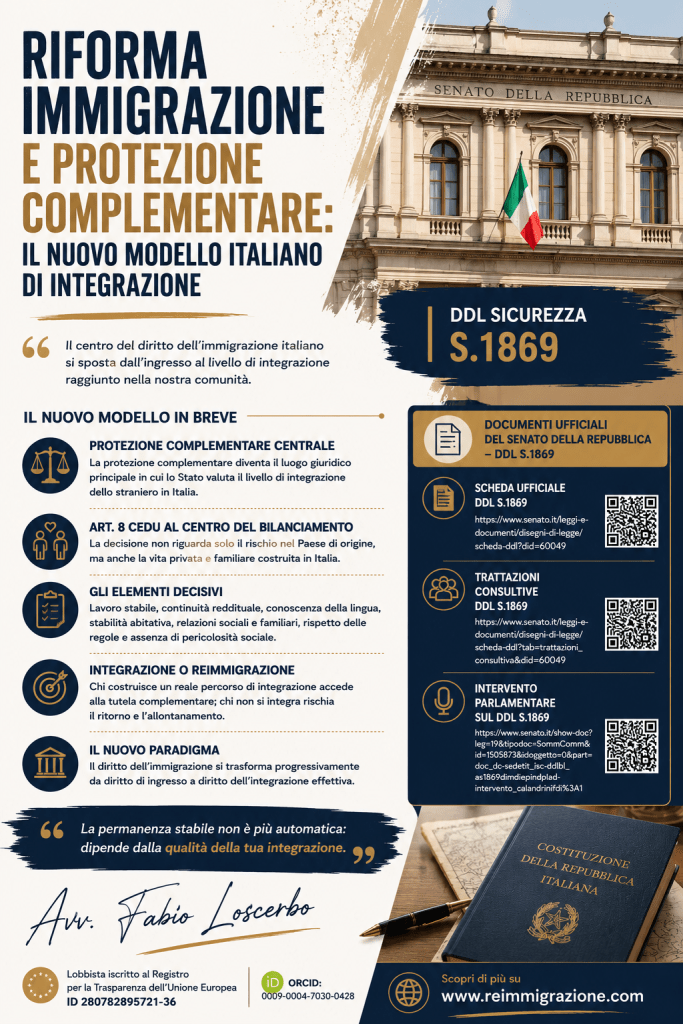
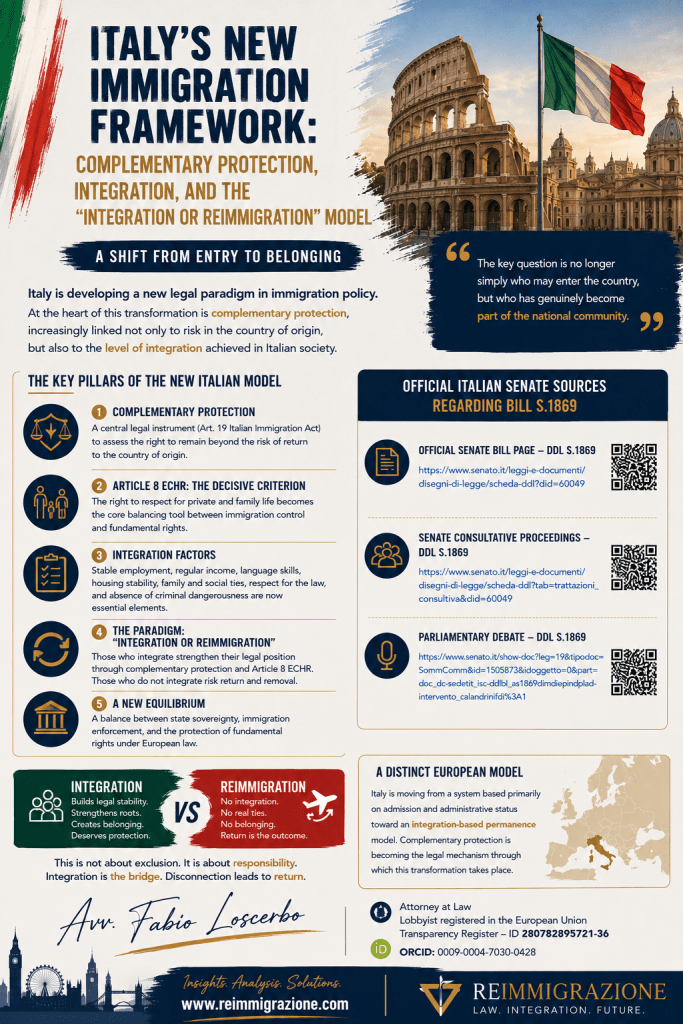
Official Italian Senate sources regarding Bill S.1869:
For British readers, it is important to understand that the Italian concept of complementary protection does not perfectly correspond either to traditional asylum protection or to discretionary humanitarian leave mechanisms familiar in the UK system.
Italy is gradually building a legal framework in which the right to remain increasingly depends not only on danger in the country of origin, but also on the degree of integration achieved within Italian society itself.
This represents a significant shift.
The legal assessment no longer focuses solely on the question: “Would the person face harm if returned?”
Instead, Italian courts and institutions are increasingly asking another question: “What private and family life has this individual already built inside Italy, and what would be destroyed through removal?”
This is where Article 8 of the European Convention on Human Rights becomes central. Article 8 protects private and family life and is progressively becoming the main balancing mechanism between immigration control and the protection of social and family ties developed by migrants within the host country.
In practical terms, factors such as stable employment, regular income, language acquisition, housing stability, family relationships, social integration, respect for the legal order, and absence of criminal dangerousness are becoming decisive in evaluating whether a person should remain in Italy.
The Italian system therefore appears to be evolving from a purely administrative immigration model into something closer to an integration-based permanence system.
It is in this context that the paradigm “Integration or ReImmigration” emerges.
The concept is not based on indiscriminate deportation, nor on unrestricted migration. Instead, it proposes a selective permanence model in which long-term residence is increasingly linked to genuine integration into the national community.
Migrants who build stable social and family ties inside Italy strengthen their legal position through complementary protection and Article 8 ECHR safeguards. Those who fail to integrate, remain socially detached, or develop no meaningful ties increasingly fall within the sphere of return and removal policies.
For a British audience, this development is particularly relevant because it reflects a broader European trend: the movement away from immigration systems based solely on entry permissions and administrative status toward systems that increasingly evaluate the legitimacy of long-term stay through integration criteria.
Italy’s Security Bill S.1869 strengthens detention, removal, and immigration control measures. At the same time, however, it also reinforces complementary protection as the legal mechanism through which integration is assessed and protected.
This creates a new balance between state sovereignty, immigration enforcement, and the protection of human rights under European legal principles.
The key question is no longer simply who may enter the country, but who has genuinely become part of the national community.
Italy therefore appears to be developing a distinct European model in which integration becomes the central condition for legitimate permanence within the host society.
Complementary protection is emerging as the legal instrument through which this transformation is taking place.
Fabio Loscerbo, Attorney at Law
Lobbyist registered in the European Union Transparency Register – ID 280782895721-36
ORCID: https://orcid.org/0009-0004-7030-0428
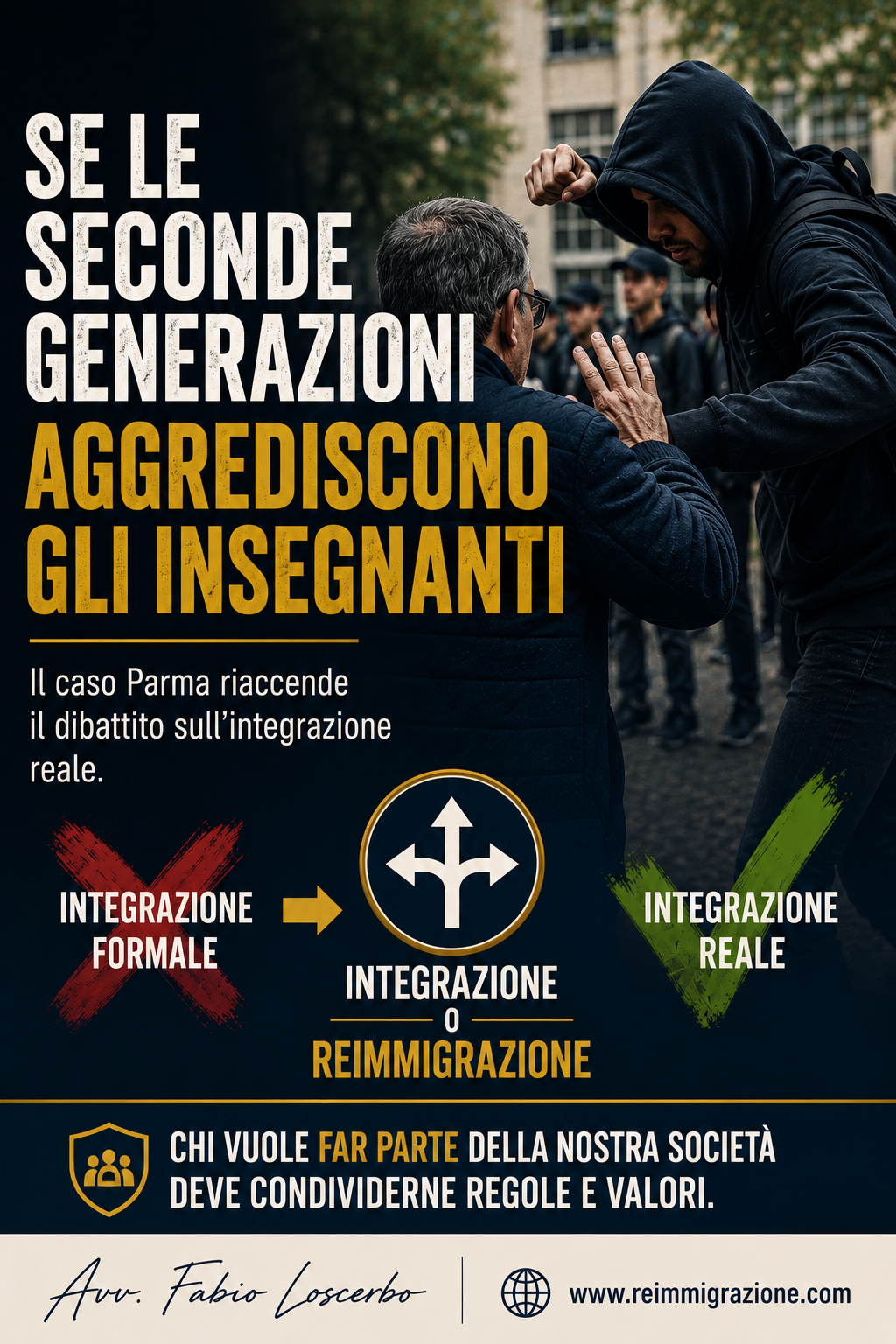
Se le seconde generazioni aggrediscono gli insegnanti
L’episodio avvenuto a Parma, dove alcuni giovani hanno aggredito degli insegnanti nei pressi dell’ITIS “Leonardo da Vinci”, rappresenta molto più di un semplice fatto di cronaca. È un episodio che riapre una domanda sempre più difficile da ignorare: cosa accade quando l’integrazione rimane soltanto formale e non riesce a trasformarsi in reale appartenenza alla comunità…

Milton Friedman aveva previsto il dilemma dell’Europa
La celebre affermazione di Milton Friedman continua ancora oggi a suscitare un dibattito enorme: “You cannot simultaneously have a welfare state and free immigration.” Per molto tempo questa frase è stata liquidata come una provocazione ideologica. Oggi, invece, appare sempre più come una delle questioni centrali dell’Europa contemporanea. Friedman non era contrario all’immigrazione in quanto…


- DDL Sicurezza 1869, protezione complementare e integrazione: il nuovo paradigma italiano
- Se le seconde generazioni aggrediscono gli insegnanti
- Milton Friedman aveva previsto il dilemma dell’Europa
- El nuevo modelo italiano de inmigración: integración, protección complementaria y derecho de permanencia
- Protezione complementare e integrazione: perché “Integrazione o ReImmigrazione” non è remigrazione