In the United Kingdom, debates about immigration usually focus on border control, legal pathways, asylum policy, and the economic contribution of migrants. Since Brexit, questions of sovereignty and control over migration have become central to political discussion. However, to fully understand the current European debate on migration, it is necessary to look at a deeper structural issue that has shaped immigration policies across the continent for decades.
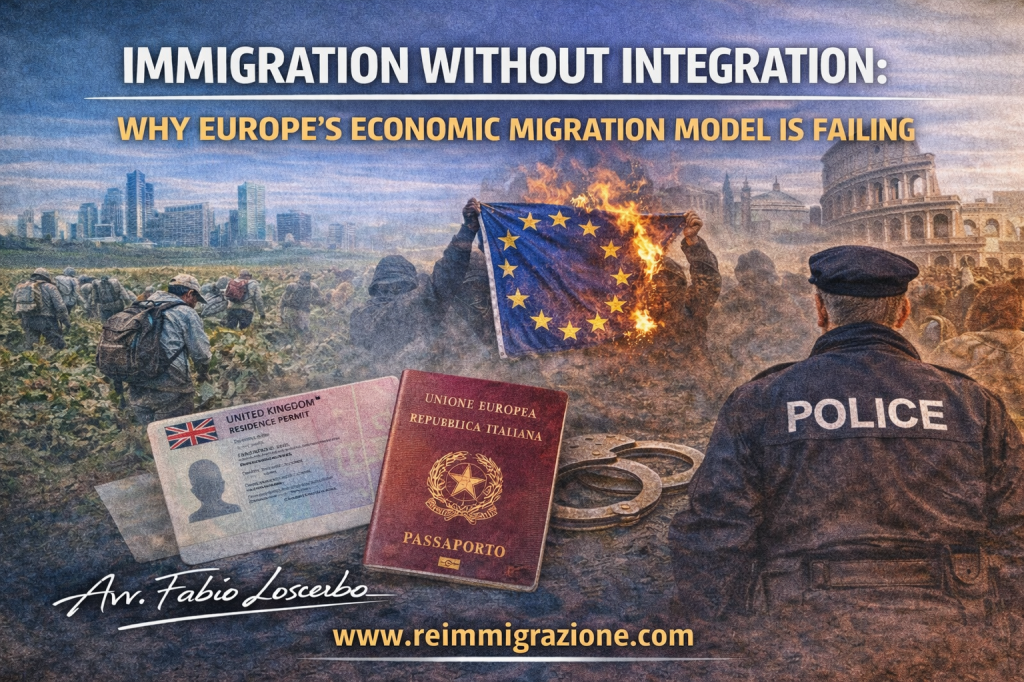
For many years, European immigration policy has been built largely around an economic interpretation of migration. Migrants have often been viewed primarily as a labour resource: workers who can compensate for demographic decline, fill shortages in sectors such as agriculture, construction, and services, and help sustain welfare systems in ageing societies.
This economic approach has influenced migration policy in many European countries. Immigration has been treated as a tool for labour market management rather than as a broader transformation of society.
Italy provides a particularly illustrative example of this model. The country regulates labour migration mainly through a quota system known as the “Decreto Flussi”, under which the government authorises a certain number of foreign workers to enter each year in response to employer requests.
In theory, the system appears logical. Employers request workers from abroad, the state allocates quotas, and migrants enter the country legally to fill labour shortages.
In practice, however, this model exposes a fundamental limitation of the economic approach to migration.
When immigration policy is designed primarily around labour demand, the central issue that determines the long-term stability of migration policy is often neglected: integration.
Migration does not only affect labour markets. It also affects communities, institutions, public services, and the social fabric of a country. The ability of migrants to integrate into the host society is therefore a key factor in determining whether immigration strengthens or destabilises a society.
Across much of Europe, migration systems are designed around two phases: entry into the territory and, theoretically, removal or deportation when residence becomes irregular. The crucial middle phase — the process through which migrants become integrated into the social and civic life of the host country — is often weakly structured or insufficiently monitored.
This gap has contributed to growing tensions in several European countries. In some areas, integration works successfully, with migrants participating fully in the labour market and social life. In others, however, long-term marginalisation and social fragmentation have emerged, raising concerns about social cohesion.
For this reason, it is increasingly necessary to move beyond a purely economic interpretation of migration and develop a new paradigm for governing migration.
This is the starting point of the “Integration or ReImmigration” paradigm.
The central idea is straightforward: the right to remain in a country should not depend solely on the existence of a job or the demand for labour in certain economic sectors. Instead, long-term residence should depend on a demonstrable process of integration into the host society.
Integration in this context does not refer to ethnic or cultural identity. It refers to concrete and measurable elements: knowledge of the language, respect for the legal order, participation in the labour market, and acceptance of the fundamental rules of social coexistence.
If integration occurs, the migrant’s residence should be stabilised and protected. If integration does not take place, the state should retain the capacity to end the residence process and organise a return to the country of origin.
It is important to distinguish this concept from another term that has recently appeared in some European political debates: “remigration.”
Remigration is often associated with identity-based political movements and proposes the systematic return of migrants considered “non-assimilated.” It is therefore largely ideological in nature.
The ReImmigration paradigm, by contrast, is grounded in a legal principle of reciprocity between the individual and the host society. Migrants are given the opportunity to build a life in the host country, but this opportunity is linked to a real and verifiable integration process.
To make such a model operational, several institutional tools are required.
One key instrument is what Italian law calls complementary protection, provided for under Article 19 of the Italian Consolidated Immigration Act. This protection may be granted to individuals who have developed strong social or family ties in the country or whose removal would conflict with fundamental rights obligations. Within an integration-based framework, complementary protection can serve as a mechanism to stabilise the legal status of migrants who demonstrate genuine integration.
A second pillar is the integration agreement, which already exists in Italian law but currently plays a relatively limited role. In a system centred on integration, such agreements would become structured pathways including language acquisition, employment participation, and civic engagement.
Another operational element could involve the temporary deposit of the migrant’s passport with immigration authorities during the integration process, ensuring administrative traceability and preventing situations in which individuals disappear from official oversight.
At the same time, the state must retain the capacity to enforce immigration decisions when integration does not occur. This may require the creation of specialised enforcement structures, such as a dedicated immigration police service, tasked with executing removal procedures.
Finally, effective enforcement requires adequate infrastructure. In Italy this role is performed by CPR facilities (Centres for Repatriation), which temporarily hold individuals awaiting deportation when voluntary departure is not possible.
The objective of the “Integration or ReImmigration” paradigm is not to close European societies to migration. Rather, it seeks to restore a balance between openness and governance.
A society can remain open to immigration only if it retains the capacity to manage the process effectively. Integration cannot be treated as a secondary objective. It must become the central criterion determining whether long-term residence is maintained.
The European experience increasingly shows that a migration model based solely on economic demand is insufficient. Labour markets change rapidly, but social cohesion remains a fundamental condition for stable democratic societies.
For this reason, moving beyond the economic model of migration is likely to become one of the central challenges of European migration policy in the decades ahead.
Avv. Fabio Loscerbo
Registered Lobbyist – European Union Transparency Register
ID 280782895721-36
ORCID: https://orcid.org/0009-0004-7030-0428

Lascia un commento