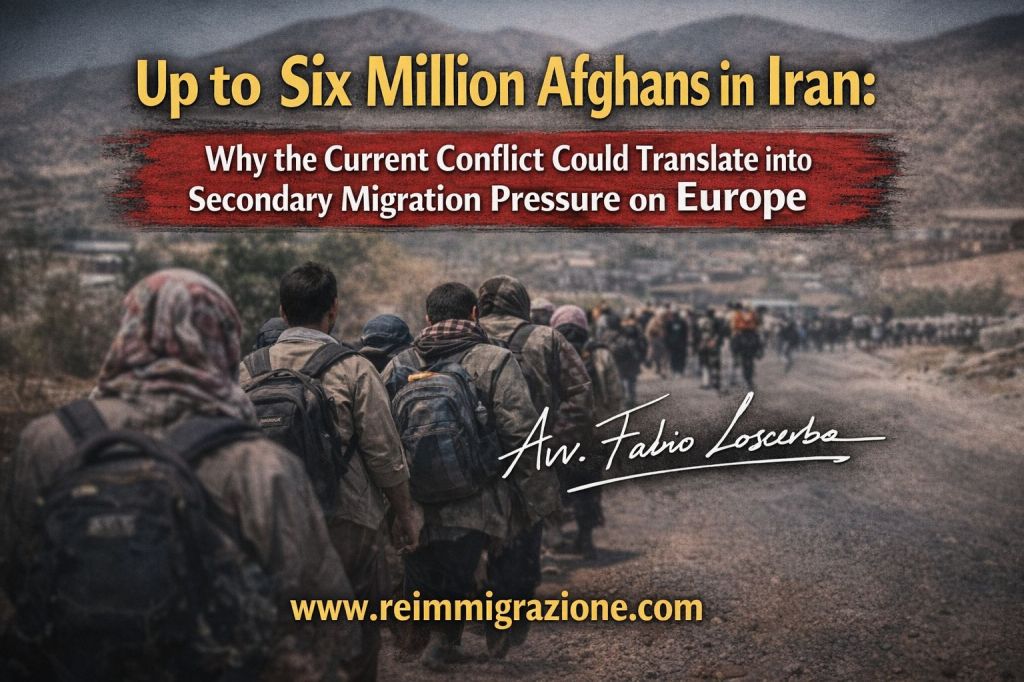
The military escalation involving Iran is not only a Middle East security story. It also has predictable second-order effects on migration dynamics, and Europe sits directly on the downstream side of those effects. Iran hosts a very large Afghan population—often estimated in the range of four to six million people, including a smaller registered refugee component and a much larger group living with precarious or informal status. When a host country that functions as a “first asylum” environment enters a phase of instability, the core migration logic is straightforward: people who were already living in legal and economic fragility tend to move again, not because they suddenly become “new” refugees from their country of origin, but because the host state can no longer provide basic security, work opportunities, or predictable rule-of-law conditions.
This is the key point American audiences should keep in mind: the potential movement is not necessarily an Afghanistan-to-Europe story; it can quickly become an Iran-to-Europe story. Secondary migration is not an ideological claim, it is a documented pattern. If inflation spikes, informal labor markets collapse, policing intensifies, or internal security deteriorates, Afghan communities in Iran will face an immediate calculus: remain in a deteriorating environment with limited legal protections, or attempt to reach a more stable jurisdiction. For many, the most plausible corridor is the well-known route through Turkey and onward to the European Union.
A mass movement of “millions” is not the most likely scenario in the short term, but Europe does not need a total exodus to face a serious challenge. Even a small share of a very large population can translate into hundreds of thousands of people on the move over a relatively short period. Once flows begin, they are difficult to manage through political statements alone; they respond to conditions on the ground, to smuggling capacity, and to perceived access to safety and long-term stability.
There is an additional, practical dimension that European policymakers cannot ignore: integration capacity. When large groups arrive within compressed time frames, integration becomes harder—structurally, not morally. Language acquisition, skills recognition, labor market entry, civic participation, and compliance with host-country rules all take time and resources. Many Afghans who have lived in Iran for years have done so in marginal conditions, often in informal employment and with uneven access to schooling or professional training. That background can make integration in European societies more demanding, especially when reception systems are already under strain and public opinion is polarized. This is not a value judgment; it is a technical reality about social systems under load.
From a United States perspective, the relevance is not to treat this as an internal European debate, but as a stability question affecting NATO partners and the broader transatlantic space. Europe’s ability to absorb sudden migration pressure influences domestic cohesion, border governance, internal security priorities, and political stability. In turn, that affects coordination on sanctions, defense posture, and broader Middle East strategy. In other words, migration pressure is often the “silent variable” that turns a regional conflict into a longer-term strategic complication for Western alliances.
For that reason, a sober, technical assessment is warranted. The risk is not inevitable, but it is real. If the conflict in Iran continues to destabilize the country’s economy and internal security, Afghan communities—already living in precarious conditions—are among the first populations likely to move. Europe is the most plausible destination. The timing and scale will depend on how quickly Iran’s internal conditions deteriorate and how effectively transit routes are controlled, but the underlying mechanism is clear: instability in a major host country can convert a long-standing refugee presence into outward secondary flows.
This is exactly the type of scenario that should be anticipated early, discussed without partisan framing, and addressed through pragmatic coordination: stabilizing conditions where possible, supporting controlled and lawful pathways where appropriate, and strengthening integration capacity and enforcement in destination countries so that social systems do not get overwhelmed. Ignoring the migration dimension until it becomes an emergency has historically been the costliest option.
Avv. Fabio Loscerbo
ORCID: https://orcid.org/0009-0004-7030-0428
EU Transparency Register ID 280782895721-36
- Integration or ReImmigrazione: Why Europe’s Immigration Debate Is About More Than Labour Shortages
- Up to Six Million Afghans in Iran: Why the Current Conflict Could Translate into Secondary Migration Pressure on Europe
- Fino a 6 milioni di afghani in Iran: il rischio reale che la guerra spinga una nuova ondata verso l’Europa
- Il comportamento conta: integrazione riuscita o ReImmigrazione
- Integration or ReImmigration: A New Immigration Paradigm Beyond Economics
- Integration or ReImmigrazione: how Italian law decides who stays and who returns
- Procedure, Identity, and Responsibility: Why Protection Requires Control
- Integración o ReImmigrazione: por qué el debate europeo va más allá del mercado laboral
- El artículo 18-ter del Proyecto de Ley italiano para la aplicación del Pacto Europeo de Migración y Asilo: ¿automatismo tras cinco años o verdadera integración?
- Integración o ReInmigración: un nuevo paradigma más allá del economicismo
- When Integration Becomes a Legal Standard
- Integration oder ReImmigrazione: Warum die europäische Migrationsdebatte über Arbeitskräfte hinausgeht
- Article 18-ter of the Italian Draft Law Implementing the EU Migration Pact: Automatic Status After Five Years or Real Integration?
- Integration or ReImmigration: A New Paradigm Beyond Economic Reductionism
- Continuing Legal Education on Complementary Protection: An Italian Perspective for a UK Legal Audience
- Quand l’intégration devient une règle juridique
- Intégration ou ReImmigrazione : quand le droit décide qui reste et qui retourne
- Intégration ou ReImmigrazione : pourquoi le débat européen dépasse la seule question économique
- L’articolo 18-ter dello Schema di Disegno di Legge recante “Disposizioni per l’attuazione del Patto dell’Unione europea sulla migrazione e asilo”: automatismo quinquennale o verifica sostanziale dell’integrazione? Un raffronto con il sistema vigente ex articolo 19 del Testo Unico Immigrazione
- Formación jurídica continua sobre protección complementaria: una perspectiva italiana con proyección europea
- Cuando la integración se convierte en condición jurídica
- Integration oder ReImmigrazione: wenn das Recht entscheidet, wer bleibt und wer zurückkehrt
- Integration or ReImmigrazione: Why Europe’s Immigration Debate Is Not Just About Labor
- Artikel 18-ter des italienischen Gesetzentwurfs zur Umsetzung des EU-Migrations- und Asylpakts: Automatischer Schutz nach fünf Jahren oder echte Integrationsprüfung?
- Juristische Fortbildung zur komplementären Schutzgewährung: Eine italienische Perspektive im europäischen Kontext
- When Integration Becomes Law
- Integración o ReImmigrazione: cuando el derecho decide quién permanece y quién regresa
- Senza verifica non c’è integrazione: oltre l’esempio spagnolo
- L’article 18-ter du projet de loi italien d’application du Pacte européen sur la migration et l’asile : automatisme après cinq ans ou véritable intégration ?

Lascia un commento