(Entering into force: July 2026)
The European Union’s new Migration and Asylum Pact, set to enter fully into force in July 2026, is presented as a turning point. After years of uncontrolled flows and political paralysis, the EU claims it has finally built a system capable of restoring order, credibility and control.
That claim is only partially true.
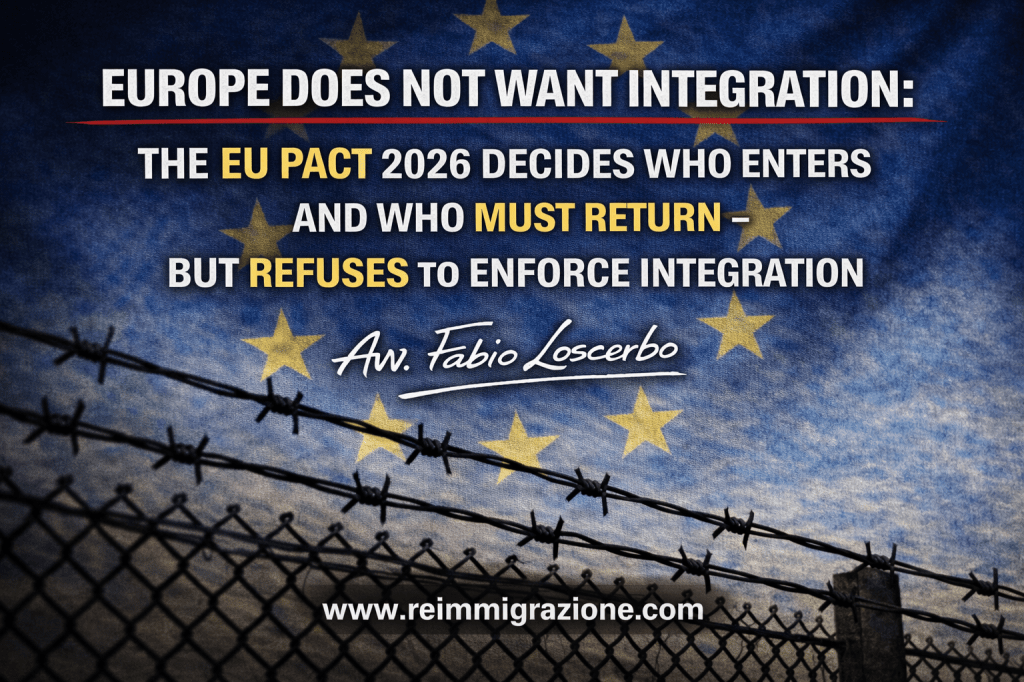
The Pact does strengthen border procedures, accelerates asylum decisions, expands biometric registration, limits secondary movements and makes returns more systematic. But it also makes a very clear — and highly questionable — political choice: it regulates entry and return while deliberately refusing to impose integration as a legal obligation on those who are allowed to stay.
This is not a drafting mistake. It is a conscious decision.
From a UK perspective, this omission is striking. British migration policy, regardless of political cycles, has always been based on a simple principle: if you are allowed to stay, you are expected to integrate. Language proficiency, respect for the legal order, economic participation and civic responsibility are seen as conditions for long-term residence, not optional extras.
The EU Pact 2026 abandons this logic.
The new framework is highly detailed when it comes to administration and enforcement. Borders are managed, databases are expanded, procedures are standardised. Migration is treated as a technical problem to be processed efficiently.
But once admission is granted, the Pact largely steps back.
Integration is mentioned only in aspirational terms. There is no binding requirement to learn the host country’s language, no enforceable obligation of civic integration, no legal consequence for persistent refusal to integrate. Residence rights are detached from any measurable demonstration of social responsibility.
In practical terms, the EU decides who may enter and who must leave, but does not require those who remain to actively integrate.
This approach undermines the very objectives the Pact claims to pursue.
The EU now openly acknowledges that unlimited entry is unsustainable and that returns must be effective. Yet it avoids the final and essential step: linking the right to stay to clear, enforceable duties. Without mandatory integration, the system produces long-term residents who are legally present but socially disconnected, fuelling mistrust, fragmentation and political backlash.
This dynamic is well understood in the UK. One of the central criticisms of past European migration policies has been precisely this: rights without responsibilities, presence without integration, legality without cohesion. The EU Pact risks reproducing this failure at continental scale.
From a rule-of-law perspective, the Pact is therefore incomplete.
Any credible migration system rests on three pillars: controlled entry, effective return of those without legal entitlement, and mandatory integration for those who are allowed to stay. The 2026 EU Pact adopts the first two and deliberately avoids the third.
The implicit message is clear: the EU prefers administrative management to social accountability. Procedures are regulated, but obligations are left undefined. Yet no migration system can remain legitimate if it answers the question “who may stay” while refusing to answer the equally fundamental question “under what conditions”.
On that point, the EU Pact remains silent.
And that silence will shape the future of European migration policy far more than any technical provision.
Fabio Loscerbo
Attorney at Law (Italy) – Bologna Bar
EU Policy Lobbyist
Registered in the EU Transparency Register
ID 280782895721-36

Lascia un commento