In recent years, the concept of remigration has entered the European debate on immigration policy with increasing intensity. The idea is associated primarily with Austrian activist Martin Sellner, a leading figure of the identitarian movement and former head of the Identitäre Bewegung Österreich.
Sellner has articulated his views in several writings and public interventions, particularly in the book Remigration: A Proposal, where he outlines what he considers a strategic response to the demographic and cultural transformations produced by immigration in Europe during the past decades.
For an American audience, this debate may seem unfamiliar at first glance. Yet the underlying issue is very similar to discussions taking place in the United States regarding border control, deportation policies, and the question of assimilation. At its core lies the same fundamental question: how should democratic states manage immigration while preserving social cohesion and legal stability?
Sellner’s answer is the theory of remigration. In his framework, remigration is not limited to the removal of undocumented migrants. Rather, it is conceived as a broader political strategy intended to reverse large-scale immigration trends. The project includes strengthening borders, revisiting residence permits granted in previous years, and promoting or enforcing the return of migrants who are considered insufficiently assimilated into European societies.
The intellectual basis of this proposal is largely cultural. According to Sellner, European societies are undergoing a demographic transformation driven by immigration from regions with different linguistic, religious, and social traditions. Remigration is presented as a way to restore what he views as the historical cultural balance of European nations.
However, this approach raises significant legal questions within the European context. Immigration policy in Europe is not governed solely by national legislation. It operates within a complex legal architecture involving national constitutions, the European Union, and institutions such as the Council of Europe.
These legal frameworks strongly protect fundamental rights, including family life, legal certainty of residence status, and protection against discrimination. Consequently, any proposal that envisions the large-scale removal of long-term residents—especially those with legal status—immediately encounters serious constitutional and legal obstacles.
Within this context, a different approach has emerged in the Italian debate: the paradigm known as Integration or ReImmigration.
This paradigm does not frame immigration primarily as a cultural or demographic issue. Instead, it treats immigration as a governance problem that must be regulated through clear legal conditions.
The central idea is straightforward: integration must become a measurable condition for remaining in the country.
Under this model, migrants who enter or remain in a country are expected to demonstrate real participation in the host society. Integration is evaluated through concrete factors such as employment, knowledge of the language, and respect for the legal order.
When integration is achieved, the state has a clear interest in stabilizing the individual’s legal position through residence permits or forms of complementary protection.
When integration fails, the legal system must provide orderly mechanisms for return to the country of origin. This process is defined as ReImmigration.
In this paradigm, ReImmigration does not represent an identity-based or demographic project. It is instead conceived as a legal instrument for regulating immigration flows when integration does not occur.
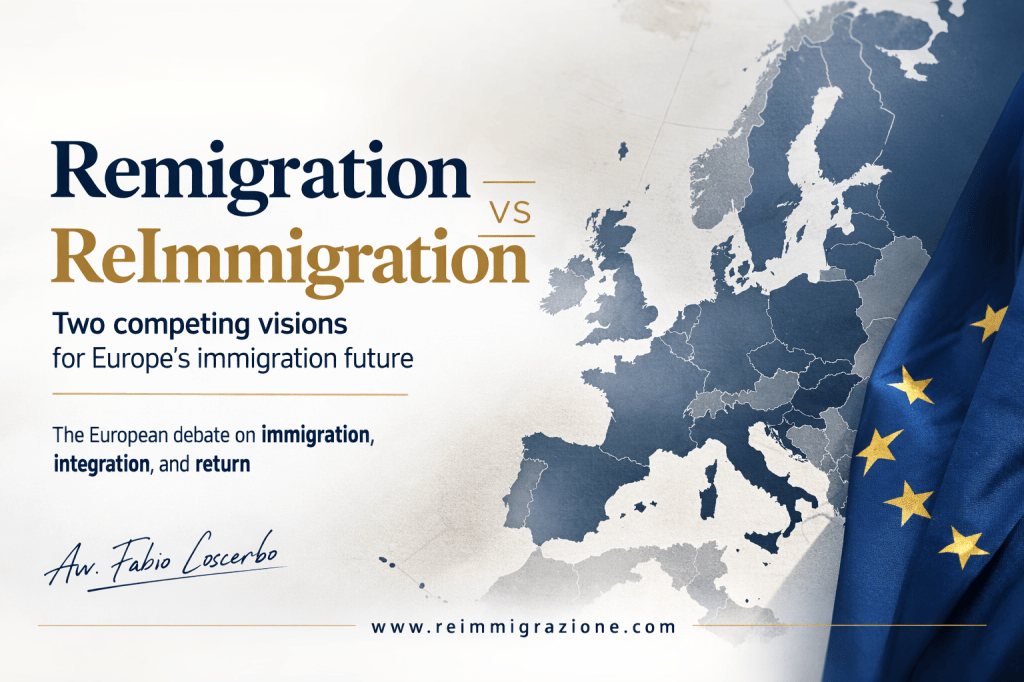
The difference between the two approaches is therefore substantial.
Sellner’s theory of remigration focuses primarily on cultural identity and demographic change. The Integration or ReImmigration paradigm focuses instead on individual integration as the decisive legal criterion.
In practical terms, this means that a person’s origin, religion, or cultural background is not the determining factor. What matters is whether the individual becomes an active and law-abiding participant in the host society.
For American readers, the distinction may resemble the difference between two traditions in U.S. immigration debates. One emphasizes national identity and demographic concerns. The other emphasizes assimilation, civic participation, and economic integration.
Europe now faces a similar crossroads.
The crucial issue is not simply how many migrants enter a country. The decisive question is how many successfully integrate into the social and legal framework of the host society.
Until immigration policies incorporate this dimension in a systematic way, European debates will likely continue to oscillate between permissive systems that fail to manage integration and radical proposals that conflict with constitutional protections.
The Integration or ReImmigration paradigm proposes a different path: a model in which immigration remains possible, but integration becomes a clear legal condition for long-term residence within democratic societies.
Avv. Fabio Loscerbo
Registered Lobbyist – EU Transparency Register ID 280782895721-36
ORCID: https://orcid.org/0009-0004-7030-0428

Lascia un commento