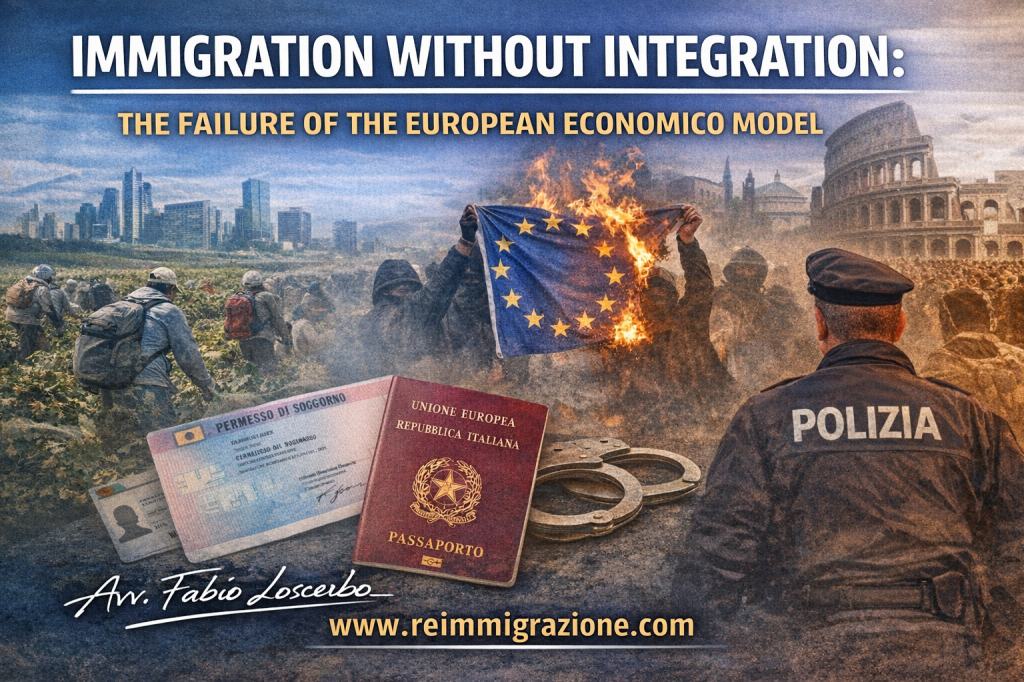
For many observers in the United States, immigration debates in Europe often appear confusing. Discussions frequently revolve around humanitarian protection, labor shortages, asylum systems, and irregular migration flows. Yet behind these debates lies a deeper structural problem that is rarely explained outside Europe: for decades, European immigration policy has been built largely on an economic interpretation of migration.
Migrants have been viewed primarily as a labor resource. The prevailing assumption has been that immigration can compensate for demographic decline, sustain welfare systems, and fill gaps in sectors such as agriculture, construction, domestic care, and services. As long as the labor market could absorb migrant workers, immigration was considered manageable.
This economic approach has profoundly shaped the architecture of migration policy across Europe.
Italy provides a particularly clear example. The principal mechanism governing labor migration is the “Decreto Flussi” (Flow Decree), a quota-based system through which the government authorizes a specific number of foreign workers to enter the country each year. Employers submit requests for workers abroad, and in theory those workers receive visas and residence permits tied to employment.
On paper, the system appears rational. In practice, however, it reveals the structural weakness of the economic model.
Immigration is treated almost exclusively as a matter of labor supply and demand. The migrant is considered a worker first, and only secondarily a future member of the national community. As a result, the system largely ignores the central issue that determines whether immigration strengthens or destabilizes a society: integration.
European policy frameworks devote enormous attention to admission procedures and legal categories of stay. They also formally provide for deportation or removal in cases of irregular presence. But the crucial middle phase — the process through which migrants become integrated into the social, cultural, and institutional life of the host country — is often weakly structured or insufficiently monitored.
This gap has produced predictable consequences across several European states. In many urban areas, integration has been uneven. Some migrants integrate successfully into the labor market and social life, while others remain trapped in conditions of marginalization. The result is growing tension between economic policy goals and social cohesion.
For this reason, a new approach to immigration governance is increasingly necessary in Europe. The model must move beyond the purely economic interpretation of migration and place integration at the center of migration policy.
This is precisely the objective of the “Integration or ReImmigration” paradigm.
The premise is straightforward: the right to remain in a country should not depend solely on the existence of a job or an employer willing to sponsor a worker. Instead, long-term residence should be connected to a demonstrable process of integration into the host society.
Integration here is not understood in ideological or ethnic terms. It refers to measurable elements of participation in the civic and institutional life of the country: knowledge of the language, respect for the legal order, participation in the labor market, and acceptance of the basic rules of social coexistence.
If integration occurs, the migrant’s legal status should be stabilized and protected. If integration fails to materialize, the state must retain the capacity to interrupt the process of residence and return the individual to the country of origin.
This framework differs fundamentally from another concept that has recently circulated in European political debates: “remigration.”
Remigration is primarily associated with certain identitarian movements in Europe. It proposes the systematic return of migrants considered “non-assimilated” or culturally incompatible with European societies. The concept is largely ideological and rooted in identity-based definitions of belonging.
The ReImmigration paradigm, by contrast, is not based on ethnic or cultural exclusion. It operates within a legal framework centered on reciprocity between the individual and the host society. The migrant is offered the opportunity to build a life in the country, but that opportunity is linked to a concrete and verifiable path of integration.
To implement such a model, several institutional instruments are necessary.
A first key tool is what Italian law defines as “complementary protection.” Under Article 19 of the Italian Consolidated Immigration Act, this form of protection can be granted when removal would conflict with fundamental rights obligations or when the individual has developed significant social and family ties in Italy. Within the Integration or ReImmigration framework, complementary protection becomes a mechanism to stabilize the legal status of migrants who demonstrate genuine integration.
A second pillar is the integration agreement, which already exists in the Italian legal system but currently plays a largely symbolic role. In a fully operational integration-based model, such agreements would function as structured pathways. They would include measurable criteria such as language acquisition, civic participation, and stable employment.
Another operational element involves administrative accountability. One possible mechanism is the deposit of the migrant’s passport with immigration authorities during the integration process, ensuring traceability and preventing situations in which individuals disappear from administrative oversight.
At the same time, the state must strengthen its capacity to enforce immigration decisions when integration does not occur. This requires the creation of specialized enforcement structures, such as a dedicated immigration police service, tasked specifically with the execution of removal procedures.
Finally, the system requires effective infrastructure for immigration enforcement. In Italy this role is played by CPR facilities (Centers for Repatriation), which are used to hold individuals pending deportation when voluntary departure is not possible. Without functional enforcement mechanisms, immigration law risks losing credibility.
The broader goal of the Integration or ReImmigration paradigm is not exclusion, but balance. A society can remain open to migration only if it preserves the capacity to govern the process. Integration must be treated not as a secondary policy objective, but as the central criterion that determines long-term residence.
The European experience demonstrates that an immigration system based purely on economic demand is insufficient. Labor markets fluctuate, but societies endure. Immigration policy must therefore be designed not only to supply workers, but to sustain social cohesion.
Only by moving beyond the economic model of migration can European states build immigration systems capable of remaining stable and legitimate in the decades ahead.
Avv. Fabio Loscerbo
Registered Lobbyist – European Union Transparency Register
ID 280782895721-36
ORCID: https://orcid.org/0009-0004-7030-0428

Lascia un commento