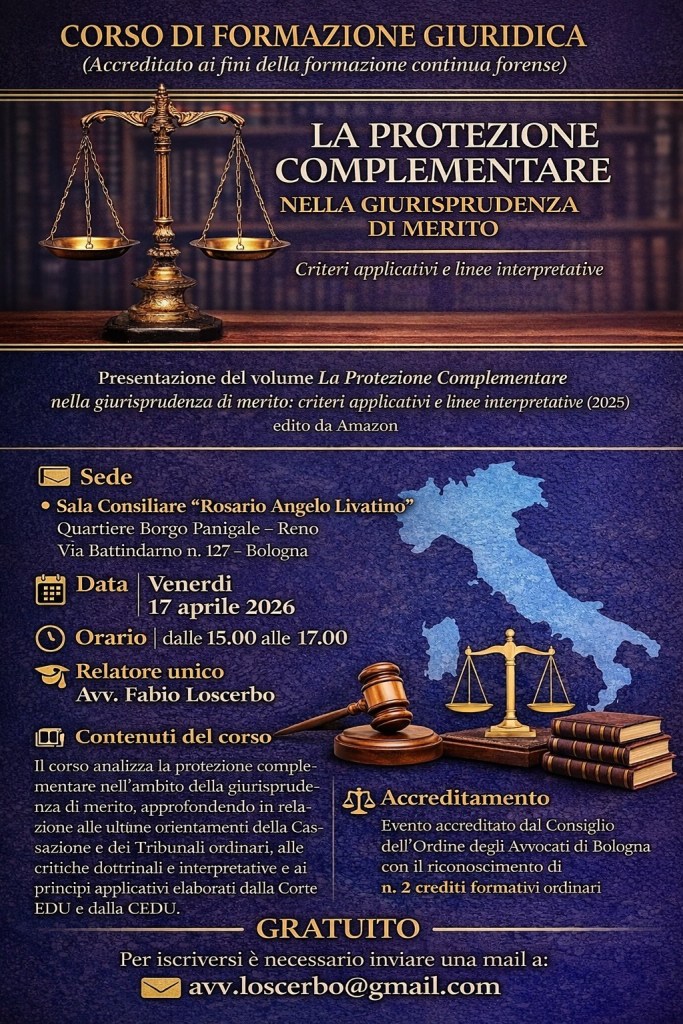
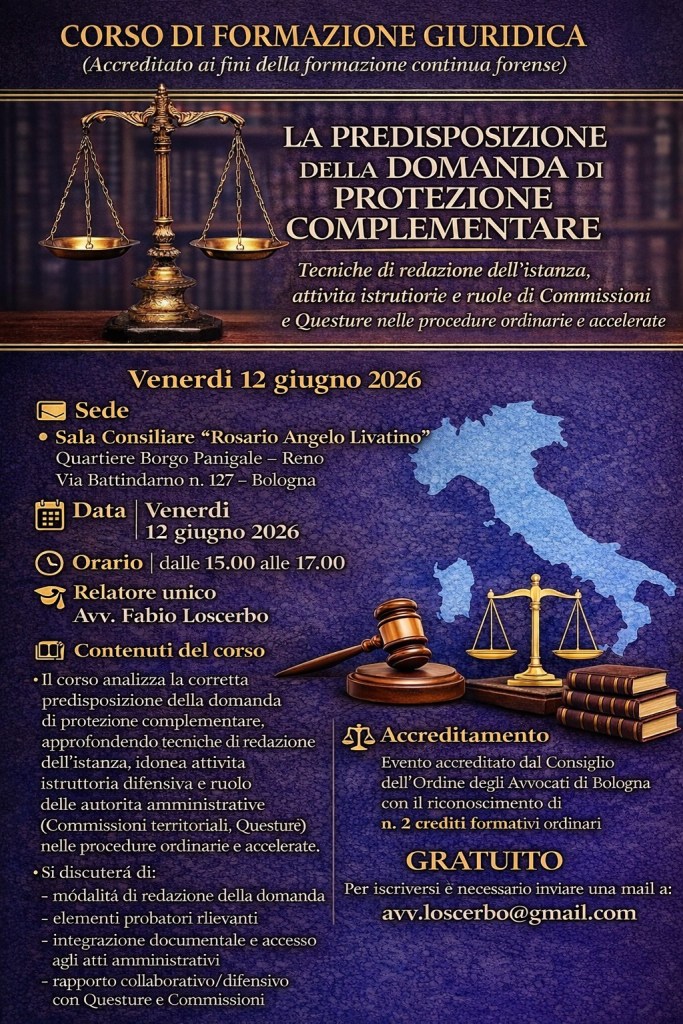
In 2026 I am organizing a structured cycle of accredited legal training seminars in Bologna, officially recognized for continuing legal education by the Bar Council of Bologna, with the attribution of two CLE credits for each event, as formally communicated by the competent Commission of the Council.
Although these programs are designed within the Italian and European legal framework, the subject matter — complementary protection as a tool of migration governance — is of clear comparative interest for U.S. lawyers, scholars, policy analysts, and immigration practitioners.
The focus of the cycle is not limited to individual relief mechanisms. It addresses a broader structural question: how a legal system manages the tension between sovereign control of migration and the protection of fundamental rights. In European law, complementary protection (under Article 19 of the Italian Consolidated Immigration Act, Legislative Decree no. 286/1998) operates alongside refugee status and subsidiary protection, functioning as a constitutional and conventional safeguard rooted in human dignity, private and family life, and proportionality principles.
The first seminar examines complementary protection in Italian lower-court jurisprudence, analyzing interpretative trends, evidentiary standards, and the interaction between domestic courts and the European Court of Human Rights. Particular attention is devoted to proportionality analysis, integration as a legally relevant factor, and the balancing between public order concerns and protected private/family life.
The second seminar develops a systemic perspective: complementary protection as an instrument of migration governance. Here, the discussion moves beyond case-by-case litigation and explores a regulatory model based on a clear paradigm — integration as a condition of lawful permanence, and reimmigration as a lawful consequence where integration fails. The comparison with other European approaches, including the German debate on “remigration,” allows for a broader reflection on how constitutional democracies can reconcile control and rights without abandoning legal certainty.
The third seminar is entirely practical and procedural. It focuses on the drafting of complementary protection applications, evidentiary construction, administrative fact-finding, interaction with Territorial Commissions and Police Headquarters, and the strategic management of accelerated procedures. The premise is simple: in contemporary migration law, technical precision determines outcomes.
For a U.S. audience, these themes resonate with debates on Temporary Protected Status (TPS), withholding of removal, Convention Against Torture claims, and prosecutorial discretion. The structural question is comparable: how does a legal system institutionalize humanitarian safeguards without dissolving the rule-based architecture of immigration control?
Anyone in the United States — attorneys, academics, think tanks, graduate students, or policymakers — who is interested in comparative materials is welcome to contact me. Upon request, I can provide teaching materials, slides, and written handouts used during the seminars, including analytical frameworks and case-based methodological notes.
The objective is not ideological advocacy but legal clarity. Complementary protection, properly understood, is not an exception to migration governance. It is part of its architecture.
Avv. Fabio Loscerbo


Lascia un commento