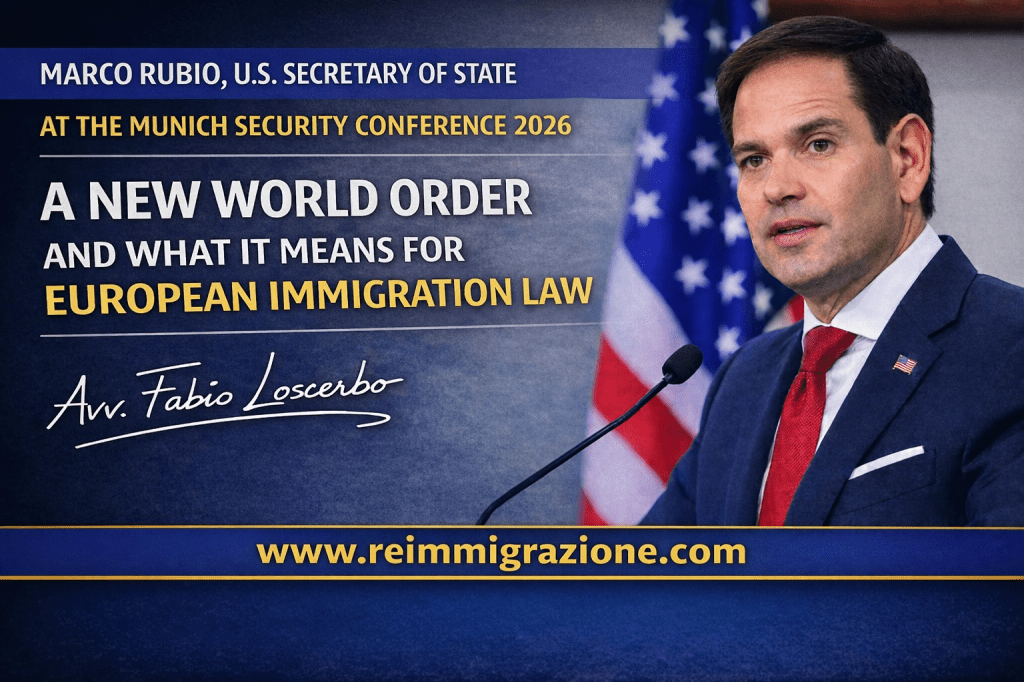
When a U.S. Secretary of State speaks at the Munich Security Conference, the message is rarely confined to diplomacy. It is a signal about the direction of the international system. Marco Rubio’s speech in Munich in 2026 should be read in that light: as an indication that the Western world is entering a new phase, where sovereignty, security and migration policy are increasingly intertwined.
For a British audience, this matters directly. The United Kingdom, even outside the European Union, faces the same structural pressures as the rest of Europe: demographic imbalance, instability in neighbouring regions, pressure on borders, and the limits of an international system designed after the Second World War. Rubio’s speech reflected a growing consensus in Washington that migration policy must be linked to national resilience and social stability.
This does not mean abandoning international obligations. It means redefining how they are applied in practice.
In Europe, immigration law operates within a layered legal framework: the 1951 Refugee Convention, the European Convention on Human Rights, and national legislation. The UK, despite Brexit, remains bound by many of these principles through international commitments and domestic human-rights law.
It is therefore essential to distinguish clearly between different forms of protection.
International protection refers to refugee status and subsidiary protection under the Refugee Convention and European law. These protections remain fundamental pillars of the rule of law.
Alongside them, some European systems apply complementary protection mechanisms, such as those provided in Italian law under Article 19 of the Immigration Act, which prevent removal when it would violate fundamental rights even if refugee criteria are not met. Comparable reasoning exists in the jurisprudence of the European Court of Human Rights and in UK case law dealing with Article 3 and Article 8 ECHR.
In a changing global order, this distinction becomes strategically important. It allows governments to manage migration realistically while still protecting individual rights. It separates genuine protection needs from uncontrolled migration flows.
This is the logic behind the paradigm I have called “Integration or ReImmigration.”
For too long, the Western debate has oscillated between two unrealistic positions: unconditional openness or total closure. Neither is workable. A sustainable migration policy must rely on verifiable criteria—employment, language, respect for the law, social integration. Those who integrate should be able to remain. Those who do not integrate, and who do not face fundamental-rights risks, should return to their countries of origin.
This is not a rejection of asylum. It is a framework for governing migration responsibly in an unstable world.
Rubio’s speech in Munich did not address European legal details, but it anticipated a political climate that will affect the UK as well as the EU. Administrative scrutiny will increase, proof of integration will matter more, and courts will continue to play a central role in balancing sovereignty and individual rights.
For the United Kingdom, the lesson is clear. Migration policy cannot be reduced to slogans. It must combine border control, legal clarity and integration standards. Otherwise, both public trust and the rule of law are undermined.
The emerging global order will not eliminate human rights. It will require them to be applied more rigorously and responsibly. In that context, complementary protection and the Integration-or-ReImmigration paradigm are not ideological slogans. They are legal tools for managing migration in a changing world.
Avv. Fabio Loscerbo
Lobbyist – EU Transparency Register No. 280782895721-36
Law Office in Bologna, Via Ermete Zacconi 3/A, Italy

Lascia un commento