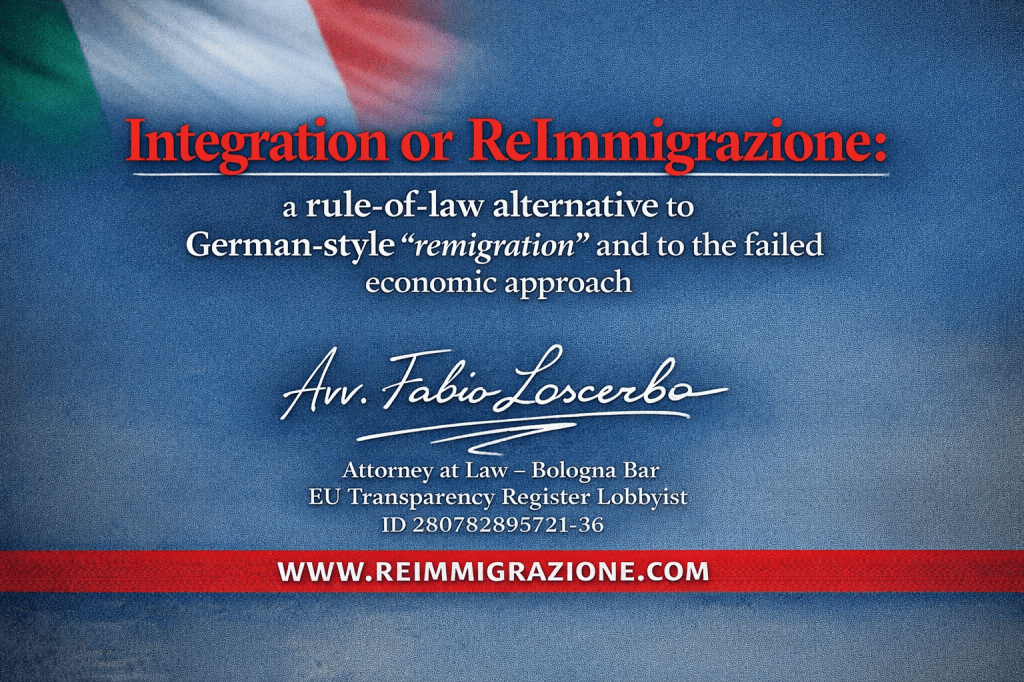
The paradigm “Integration or ReImmigrazione” is not a slogan and not an ideological reaction. It is a rule-of-law framework designed to address a structural failure that Western immigration systems, including European ones, have largely avoided confronting: immigration policies have been reduced to labor market management, while integration has been treated as optional, symbolic, or purely cultural.
For decades, immigration has been justified almost exclusively in economic terms. Migrants are accepted as long as they work, and become legally fragile the moment they fall out of employment. In this system, work is not a sign of integration; it becomes a substitute for it. The result is predictable: legal insecurity, social tension, and a permanent state of exception where rules exist on paper but are rarely enforced.
The Integration or ReImmigrazione paradigm starts from a different premise: integration is not an economic function, it is a legal and civic obligation. Employment matters, but it is only one indicator among others. Language proficiency, respect for the legal order, civic behavior, and loyalty to the host country’s rules are equally decisive. Work is evidence of integration, not its legal foundation.
This approach deliberately distances itself from the concept of “remigration” as it has emerged in parts of the German political debate. That model often relies on collective, ideological, or identity-based assumptions and raises obvious constitutional and rule-of-law concerns. ReImmigrazione, by contrast, is individual, conditional, and legally grounded. It is not about origin or ethnicity; it is about conduct, responsibility, and compliance with clearly defined rules.
A key element of this paradigm is the revival of a tool that already exists in Italian law: the Integration Agreement, introduced by the Berlusconi government with the explicit goal of making integration measurable and enforceable. The agreement was designed to define concrete obligations—language, civic education, lawful behavior—and to link the right to stay to demonstrable compliance. Today, this mechanism still exists formally, but it has been largely neutralized and emptied of real consequences.
Where the paradigm becomes operational today is in the system of complementary protection, which functions as a real-world testing ground for Integration or ReImmigrazione. Complementary protection does not grant an unconditional right to remain. It is based on an individualized assessment of social integration, legal behavior, and proportionality. Crucially, the procedure includes the mandatory deposit of the passport with the immigration authorities.
This detail is not administrative trivia. It is a structural guarantee. It ensures that, if integration fails, the State retains the practical ability to execute ReImmigrazione. Integration and enforcement are not opposites; they are two sides of the same system. A policy that cannot enforce departure is not humanitarian—it is simply non-governing.
From an American perspective, this logic is not foreign. The United States has always understood that immigration policy requires both opportunity and enforcement. What Integration or ReImmigrazione adds is a missing middle layer: conditional inclusion. The right to stay is neither automatic nor permanent; it is earned, verified, and maintained through behavior.
A serious immigration system must be able to say both “you can stay” and “you must leave,” and must be capable of enforcing both decisions. Without that capacity, sovereignty becomes rhetorical and the rule of law collapses into selective tolerance.
Integration or ReImmigrazione is not radical. It is institutional realism. Those who integrate stay. Those who do not, return. Anything else is delay disguised as policy.
Attorney at Law – Bologna Bar
EU Transparency Register Lobbyist
ID 280782895721-36

Lascia un commento