
Giorno: 25 febbraio 2026
-
Integration or ReImmigrazione: Why Europe’s Immigration Debate Is Not Just About Labor
In recent European discussions, Spain is often presented as a pragmatic and forward-looking model of immigration management. Two recent Italian publications illustrate this narrative clearly. The first, “L’immigrazione regolare come leva di sviluppo economico: il caso spagnolo”, published by 7Grammilavoro (https://www.7grammilavoro.com/limmigrazione-regolare-come-leva-di-sviluppo-economico-il-caso-spagnolo/), argues that regular migration can function as a lever for economic development. The second, “Migranti: la Spagna sceglie l’integrazione”, published by Il Bo Live – University of Padua (https://ilbolive.unipd.it/it/news/societa/migranti-spagna-sceglie-lintegrazione), presents Spain’s policies as a deliberate political choice in favor of integration rather than restriction.
Both articles describe Spain as a country that has expanded legal pathways, implemented regularization measures, responded to labor shortages, and attempted to stabilize its demographic structure. Immigration, in this framework, is not portrayed as a threat but as a resource. If regulated and aligned with economic needs, it becomes a driver of growth.
For an American audience, this reasoning sounds familiar. Immigration in the United States has long been discussed in economic terms: workforce shortages, tax contributions, entrepreneurship, innovation, demographic renewal. The central question often becomes whether migrants contribute more to the system than they receive.
Yet the current European debate — especially in Italy — is increasingly moving beyond this economic framing. The question is no longer simply whether immigration supports GDP or public finances. The more fundamental question is whether economic contribution alone is sufficient to justify permanent residence within a political community.
The economic argument is not wrong. Migrants work, pay taxes, contribute to social security systems, and fill structural labor gaps. Spain’s recent approach, as described in the articles cited above, shows that legal channels can reduce irregularity and improve labor market transparency. However, economic functionality is cyclical. Labor demand expands and contracts. Entire sectors rise and decline. Economic growth fluctuates.
If the primary justification for immigration is labor demand, what happens when that demand changes? If economic growth slows or unemployment rises, does the legitimacy of permanent presence weaken? A nation cannot be governed as if it were a corporation adjusting personnel according to quarterly performance. Permanent residence entails access to welfare systems, family reunification, long-term settlement, and social cohesion. These are structural dimensions of statehood, not temporary economic adjustments.
This is where the paradigm I propose — Integrazione o ReImmigrazione — enters the debate. ReImmigrazione remains ReImmigrazione. It is not merely “return policy” in the abstract; it is the structured and orderly consequence of a failed integration process.
Integration, in this framework, is not a political slogan or a moral aspiration. It is a verifiable pact between the State and the individual. It requires stable employment, linguistic competence, and consistent respect for the legal order. It implies reciprocity. The State guarantees rights and legal protection; the individual assumes obligations and demonstrates integration in measurable ways.
If integration succeeds, permanence is legitimate and stable. If integration fails, permanence cannot be automatic or irreversible. In such cases, an orderly and legally structured process of ReImmigrazione must be possible.
The Spanish model, as portrayed in the two cited articles, emphasizes inclusion and regularization. It focuses on opening legal channels and facilitating access to the labor market. These are important components of policy. Yet what remains less clear is the mechanism of verification over time. What happens if employment becomes unstable? What happens in cases of systematic non-compliance with the legal order? What institutional instruments ensure that integration is not presumed but demonstrated?
Without verification, integration risks becoming a political declaration rather than a binding condition. Without responsibility, inclusion becomes automatic stabilization.
For American readers, this debate may resonate differently because the United States has historically framed immigration within a civic integration narrative tied to constitutional values and national identity. Yet even in the U.S., questions of border control, asylum reform, and interior enforcement reveal the same underlying tension: economic utility does not exhaust the institutional dimension of immigration policy.
The European discussion is therefore not about choosing between openness and closure. It is about defining the foundation of permanence. Should permanent residence be grounded primarily in economic contribution, or in a broader and enforceable concept of integration?
Integrazione o ReImmigrazione proposes a clear answer. Immigration is legitimate when integration is real, measurable, and sustained. If that integration breaks down, the State must retain the capacity to enforce an orderly return. This is not a rejection of immigration. It is a structured approach to sovereignty and responsibility.
Economic growth can justify entry.
Only integration can justify permanence.ReImmigrazione is the necessary counterpart to integration — not its negation, but its guarantee.
Avv. Fabio Loscerbo
Lobbista – Registro per la Trasparenza dell’Unione Europea
ID 280782895721-36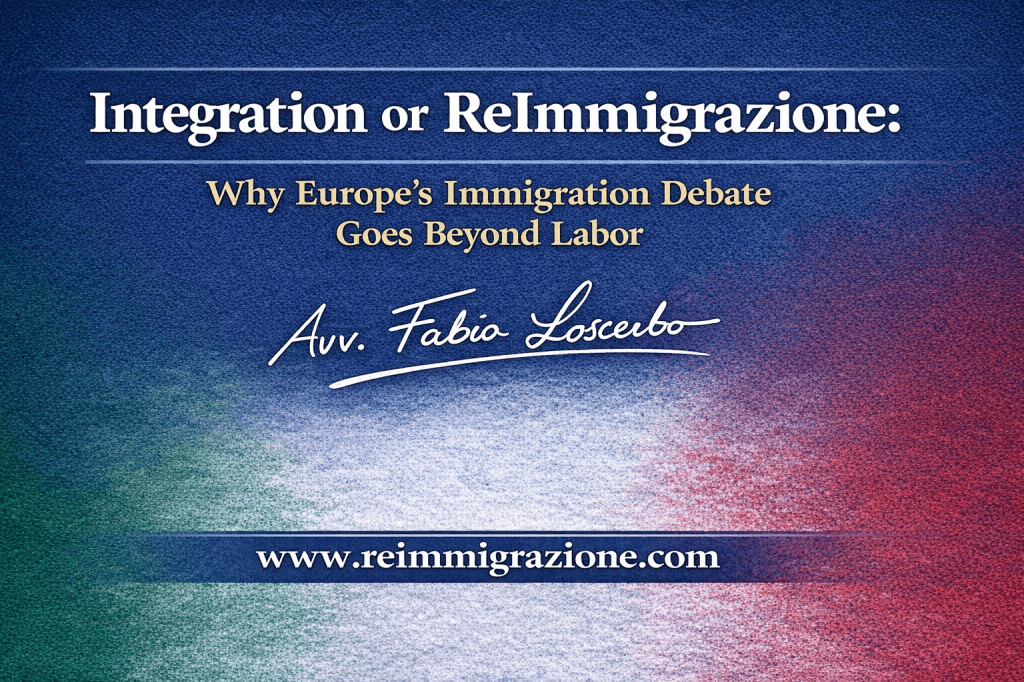
Articoli
-
Juristische Fortbildung zur komplementären Schutzgewährung: Eine italienische Perspektive im europäischen Kontext
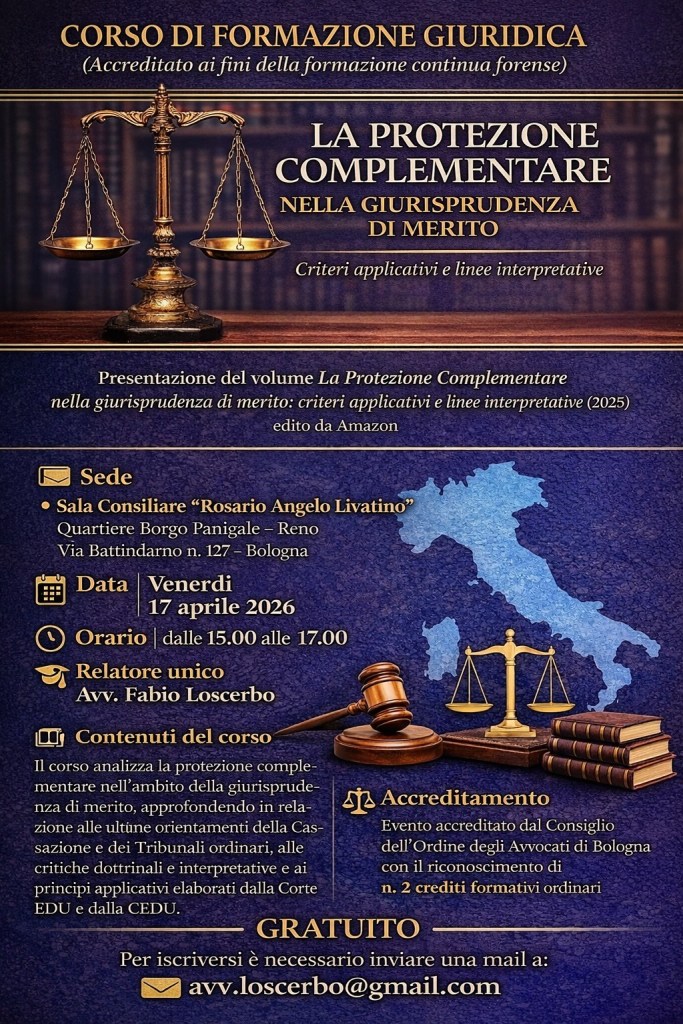
Im Jahr 2026 veranstalte ich in Bologna eine strukturierte Reihe juristischer Fortbildungsseminare, die vom Consiglio dell’Ordine degli Avvocati di Bologna im Rahmen der anwaltlichen Fortbildungspflicht offiziell akkreditiert wurden. Für jede Veranstaltung werden zwei Fortbildungspunkte anerkannt, wie aus der formellen Mitteilung der zuständigen Kommission hervorgeht .
Auch wenn diese Seminare im italienischen und unionsrechtlichen Kontext verankert sind, sind die behandelten Fragestellungen von unmittelbarem Interesse für ein deutsches Fachpublikum – insbesondere für Rechtsanwälte im Migrationsrecht, Verwaltungsrichter, Wissenschaftler, politische Entscheidungsträger und Think Tanks.
Der komplementäre Schutz nach Art. 19 des italienischen Einwanderungsgesetzes (Legislativdekret Nr. 286/1998) ist kein bloßes Randinstitut. Er fungiert als rechtliches Korrektiv innerhalb eines Systems, das staatliche Steuerung von Migration mit dem Schutz der Grundrechte in Einklang bringen muss. Im Zentrum stehen Fragen der Menschenwürde, des Schutzes des Privat- und Familienlebens sowie der Verhältnismäßigkeit, stets im Lichte der EMRK und der EU-Grundrechtecharta.
Das erste Seminar widmet sich der komplementären Schutzgewährung in der italienischen Tatsachen- und Instanzrechtsprechung. Analysiert werden die Anwendungsmaßstäbe der ordentlichen Gerichte, die Rolle der Kassationsrechtsprechung sowie das Zusammenspiel mit der Rechtsprechung des Europäischen Gerichtshofs für Menschenrechte. Ein Schwerpunkt liegt auf der Bedeutung von Integration als rechtlich relevantes Kriterium sowie auf der beweisrechtlichen Struktur der Verfahren.
Das zweite Seminar entwickelt eine systemische Perspektive: Komplementärer Schutz als Instrument der Migrationssteuerung. Dabei wird ein klares Paradigma diskutiert – Integration als Grundlage für rechtmäßigen Verbleib, Reimmigration als rechtliche Folge des Scheiterns des Integrationsprozesses. Der Vergleich mit der deutschen Debatte über „Remigration“ ermöglicht eine sachliche, juristisch fundierte Auseinandersetzung mit Fragen der Steuerungsfähigkeit moderner Rechtsstaaten unter Beachtung unions- und konventionsrechtlicher Grenzen.
Das dritte Seminar ist praxisorientiert. Es behandelt die Ausarbeitung von Anträgen auf komplementären Schutz, die strukturierte Beweisführung, den Zugang zu Verwaltungsakten sowie die Zusammenarbeit mit den zuständigen Verwaltungsbehörden in ordentlichen und beschleunigten Verfahren. In einem Umfeld, in dem Verfahrensbeschleunigung zunehmend zur Regel wird, entscheidet methodische Präzision über den Ausgang des Verfahrens.
Für ein deutsches Publikum sind diese Themen unmittelbar anschlussfähig an Diskussionen über subsidiären Schutz, Abschiebungsverbote, Art. 8 EMRK, Integrationskriterien sowie die Rolle der Verwaltungsgerichte im Asyl- und Aufenthaltsrecht. Die strukturelle Herausforderung ist vergleichbar: Wie lässt sich Migration steuern, ohne die Grundrechtsbindung des Staates preiszugeben?
Interessierte Fachkollegen, Universitäten oder Forschungseinrichtungen im deutschsprachigen Raum können sich gerne direkt an mich wenden. Auf Anfrage stelle ich didaktische Materialien, Präsentationen und schriftliche Unterlagen zur Verfügung, die im Rahmen der Seminare verwendet werden, um einen vertieften rechtsvergleichenden Austausch zu ermöglichen.
Komplementärer Schutz ist kein politisches Schlagwort, sondern ein präzises juristisches Instrument. Seine richtige Einordnung entscheidet über die Kohärenz des gesamten migrationsrechtlichen Systems.
Avv. Fabio Loscerbo


Articoli